Flashback : Dallas

A Miscellany: History, Ads, Pop Culture

Category: Photographs

“All the Beer You Can Drink In an Hour For 60 Cents” — 1935

beer_60-cents_AP_1935LOOK!

by Paula Bosse

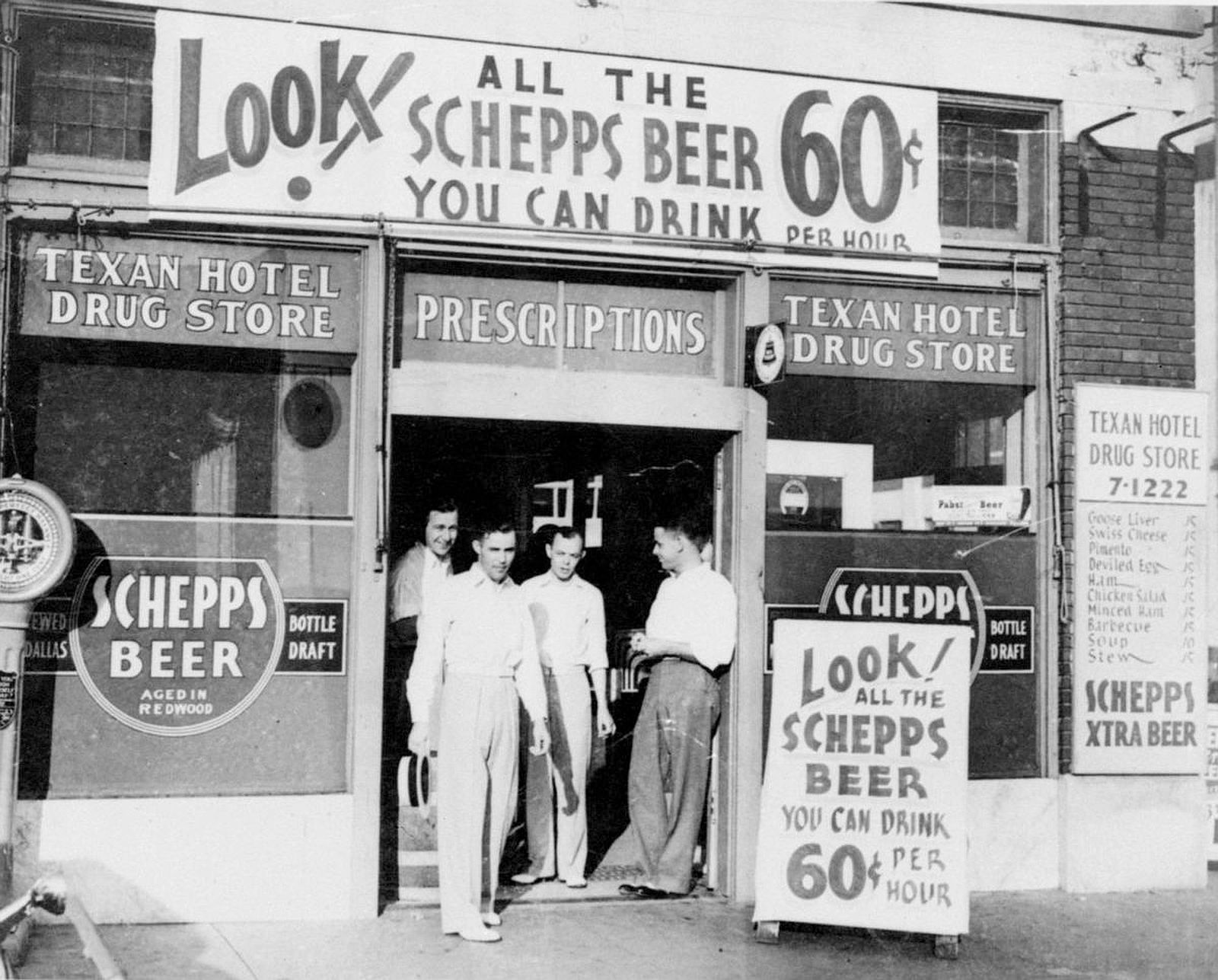
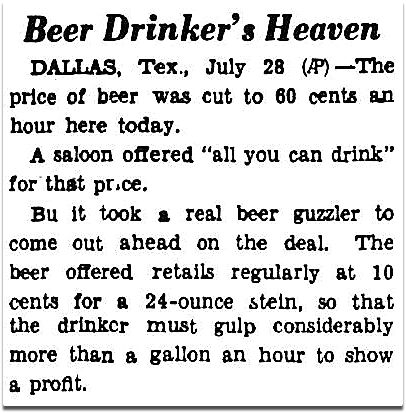
Summertime in Big D. It’s hot. REAL hot. For some, the only way to properly slake that nagging thirst is with a tall frosty mug of beer. In the summer of 1935, the management of the Texan Hotel Drug Store (at the northeast corner of S. Houston and Jackson streets) decided to offer a headline-grabbing promotion: “ALL THE SCHEPPS BEER YOU CAN DRINK: 60¢ PER HOUR!” (60¢ in 1935 would be the equivalent of about $11.00 today.) Sounds like a bargain, right? Maybe. Depends on your constitution — it meant that you would have to consume over a gallon of beer in one hour to save any money. (Not a problem for some, I realize.)

This made national news — there’s even newsreel footage. The photo above is from an AP wire story, accompanied by this caption: “A Dallas beer parlor offered ‘all the beer you can drink’ for 60 cents an hour. There were plenty of takers, but the proprietor said none had beaten him. The drinker would have to consume more than nine pints an hour to show a profit.”

beer_scranton-PA-repubican_072935
Scranton (PA) Republican, July 29, 1935

Speaking of newsreel footage, you can watch it here. As you can see, there certainly were a lot of very enthusiastic Dallas beer-drinkers doing their very best to surpass that gallon hurdle in order to feel they’d spent their money (and their hour) wisely.

Ah, back when you could guzzle beer in a drugstore. (Several drugstores that same year — including this one — were routinely getting busted for selling illicit whiskey.)

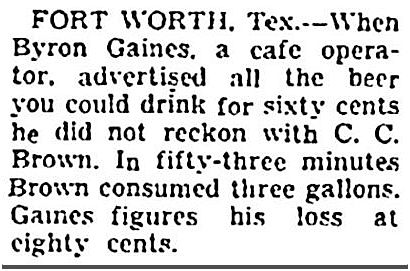
The promotion appears to have been a hit, both publicity-wise and beer-sales-wise. The Dallas proprietor said no drinker had managed to come out ahead, but in Fort Worth, men appear to be made of stronger stuff. Cafe operator Byron Gaines hadn’t anticipated Chauncey C. Brown, a hops-loving patron described as “heavy-set” and “amiable.”

beer_FW_olean-NY-times-herald_081235Olean (NY) Times Herald, Aug. 12, 1935

According to United Press reports (this made national news, too), Brown took 58 minutes (rather than 53), but that “seven minutes of that time was spent in playing a slot machine.” It’s good to have hobbies.

***

Sources & Notes

AP photo, taken in July 1935, from the Press of Atlantic City site, here

Newsreel footage is from Critical Past (and can be purchased), here.

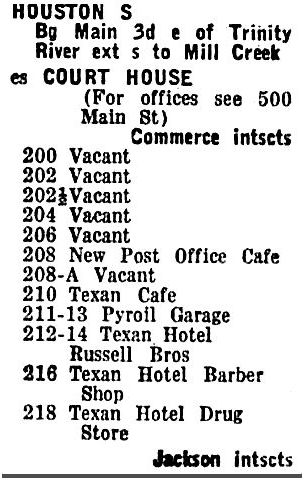
The Texan Hotel Drug Store was located at 218 S. Houston St. (northeast corner of Houston and Jackson) — see what the corner looks like today, here.

texan-hotel_south-houston_1936-directory
1936 Dallas directory

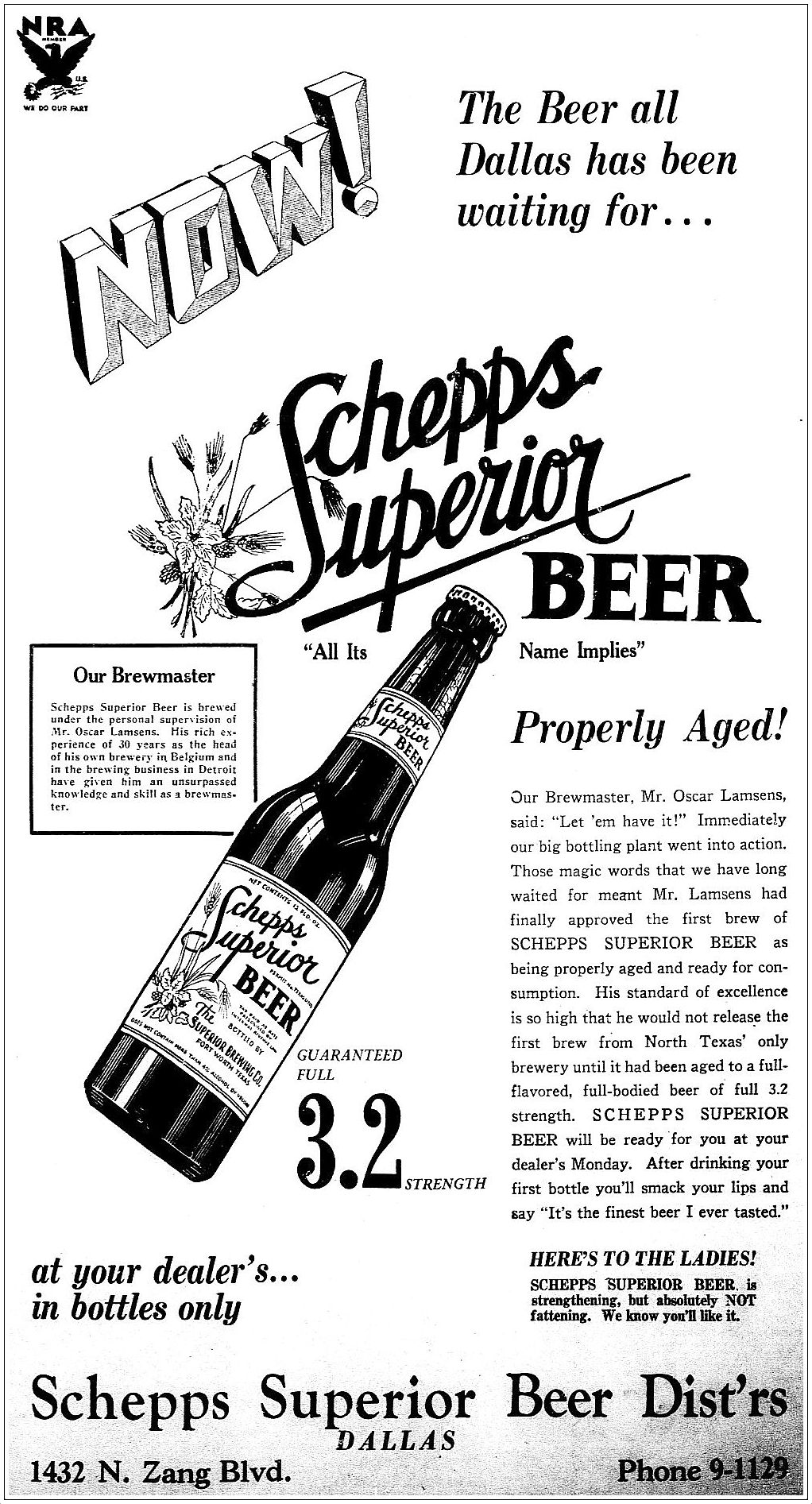
And … Schepps Beer? I was familiar with Schepps dairies, but not a Schepps brewery. But, yes, the same Schepps family produced highly guzzleable beer. The Schepps Brewing Co. launched in 1933 and lasted into the early ’40s; their downtown brewery was located on Young Street, about where the current City Hall/Convention Center now stand. (Schepps Beer was founded by brothers Julius Schepps and George Schepps, sons of pioneer Dallas baker Joe Schepps, whose Schepps Bakery was a highly profitable business. Joe’s brother Nathan Schepps joined his brother in Dallas about 1912 and started his Schepps Dairy by following his brother’s bakery wagons with his dairy wagon and selling his products to his brother’s customers. So even though it’s not a DIRECT family link, it’s pretty close: Julius and George Schepps were the  nephews of the founder of the very long-lived Schepps Dairy. ALSO, their sister, Rebecca Schepps, married Carl Metzger, son of another Dallas dairy titan, Jake Metzger. So the beer guys had close ties to two of the largest local dairies.)

Read a very entertaining interview with George Schepps in the September 1981 D Magazine article “Uncle George” by Connie Durham, here (scroll down for his memories of Schepps Beer).

Scheppps Xtra Light Lager (“light” meaning a light lager, not a beer low in calories) made a brief return to Dallas shelves in 1978 when the Julius Schepps Wholesale Liquor Co. brought it back; it was brewed at the Spoetzl Brewery in Shiner and was sold in “shortnex” bottles (stubby non-longnecks). More can be found in the Dallas Morning News article “Dallas Firm Bottles Touch of Nostalgia” by Dennis Fulton (DMN, July 9, 1978).

(Click pictures and articles to see larger images.)

schepps-beer_nov-1933Nov. 1933

schepps-beer_aug-1934Aug. 1934

schepps-beer-bottle-cap

*

Copyright © 2018 Paula Bosse. All Rights Reserved.

Year-End List! My Favorite Images Posted in 2017

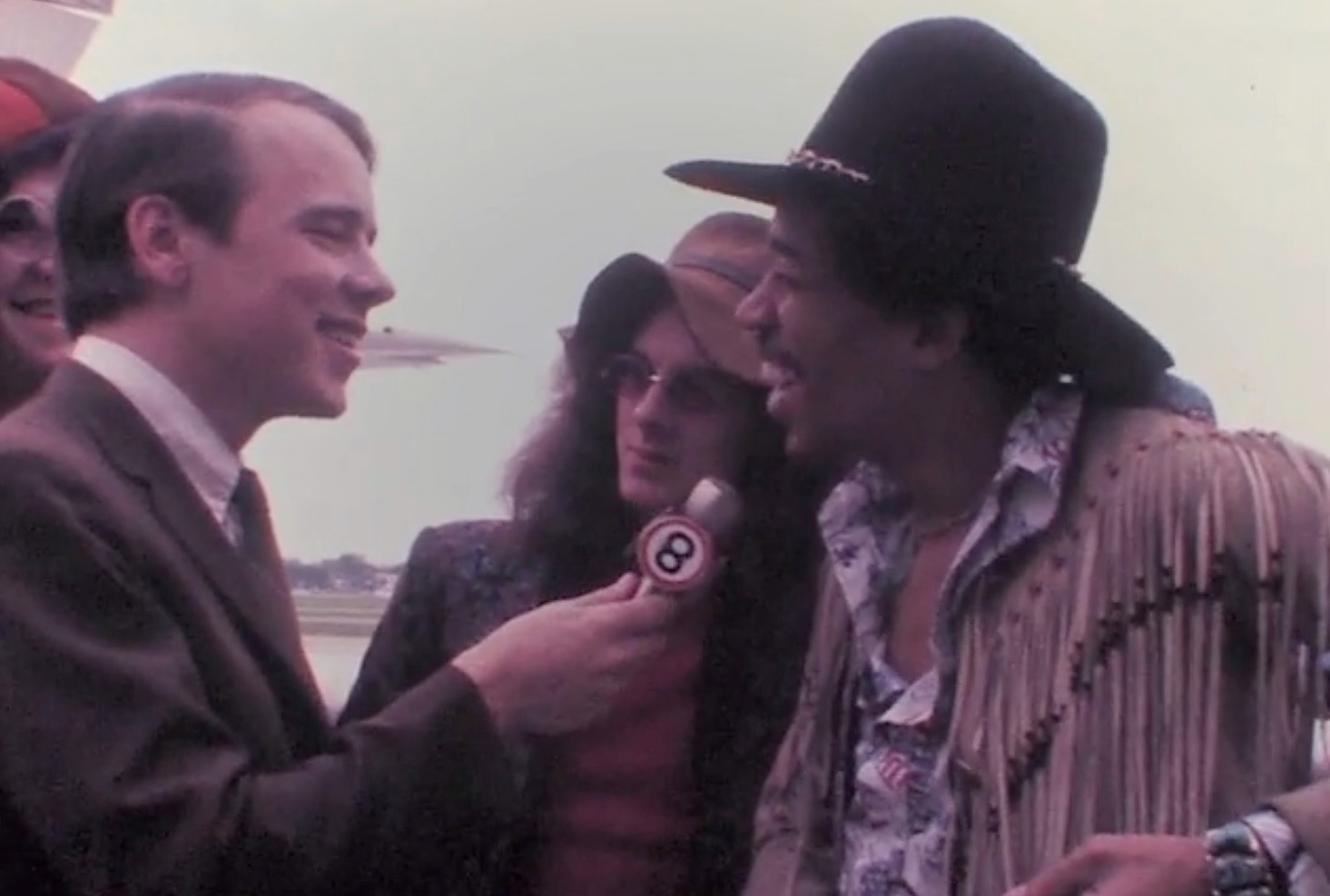
jimi_wfaa_hamon_smu-1Love Field was never cooler… (click for larger image)

by Paula Bosse

Another year is ending — time for lists! This is the first of three year-end “favorites” lists — this one contains favorite photos and artworks posted over the past year. To see the post they originally appeared in, click the title of the post, and to see a larger image of the picture, click the picture. They’re in no particular order, although, the one above is my favorite of 2017.

***

The image above is not a photograph but a video screen-capture of newly unearthed WFAA-Channel 8 news footage of Jimi Hendrix and The Experience, on the Love Field tarmac, being interviewed by a charmingly agog Channel 8 reporter. This short interview is one of the coolest things I’ve seen all year. Watch the video — it’s in the post “Jimi Hendrix, Glen Campbell, Tiny Tim — In Dallas (…Separately), 1969.”

*

whittle-music_elm-and-murphy_flickr_red-oak-kid

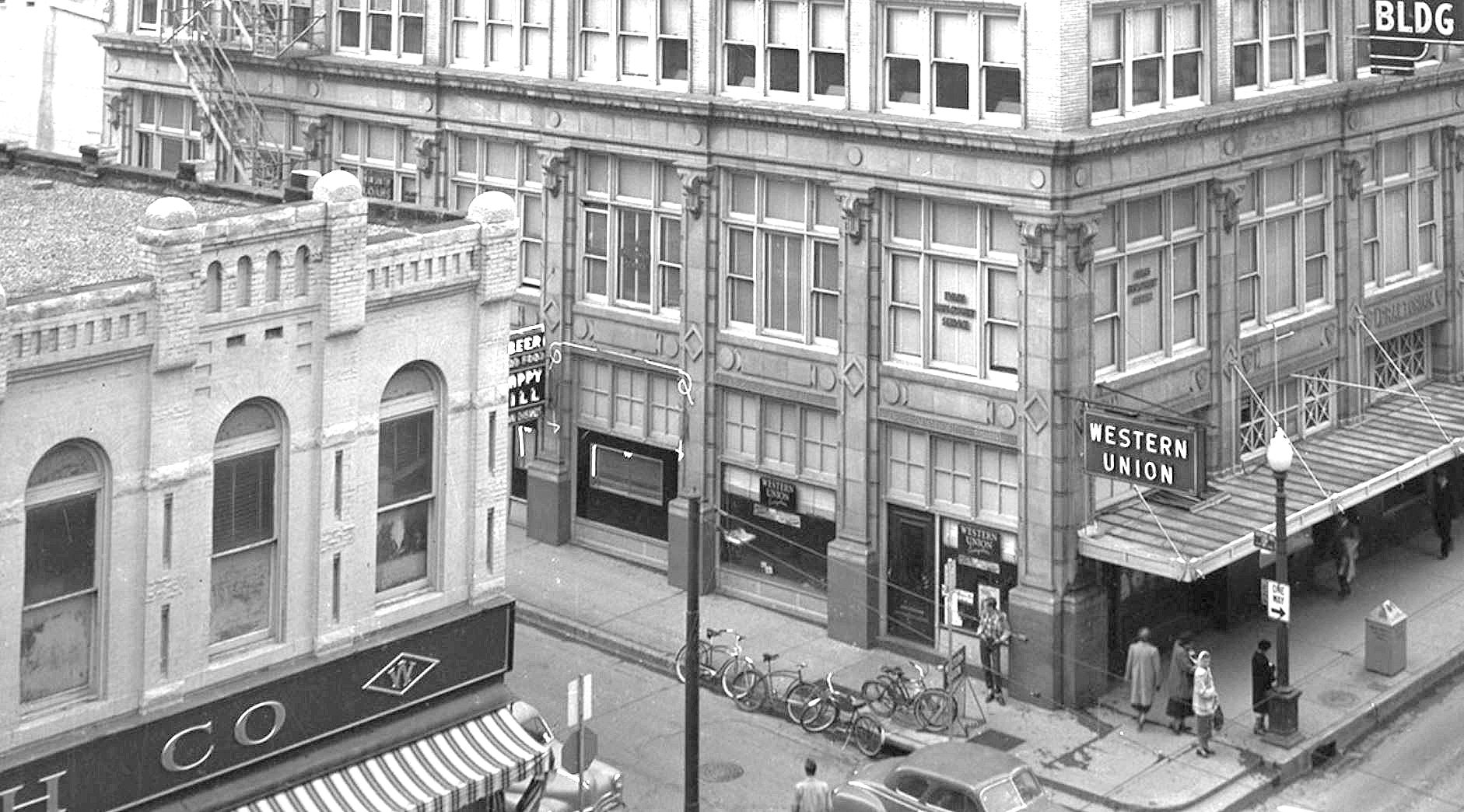
Above, the Whittle Music Co. building, 1108 Elm Street, around 1956. It was built in 1892 and originally housed the A. Harris department store (until 1914). Whittle’s occupied this beautiful building from 1941 until 1965, when it moved to Oak Lawn. The building was bulldozed soon afterwards in order to  begin construction of One Main Place. Read more about all of this at the post The Whittle Music Building — ca. 1956.”

*

main-and-stone_praetorian_haskins_UTA_det

This is actually a detail of a larger 1953 photo by Squire Haskins (seen here), showing the intersection of Main and Stone Place, looking northeast. The building on the left is still standing and is one of the oldest buildings downtown. See more at the post “The Praetorian Building and Its 19th-Century Neighbors.”

*

baseball_dallas-clippers_cook-coll_degolyer_smu

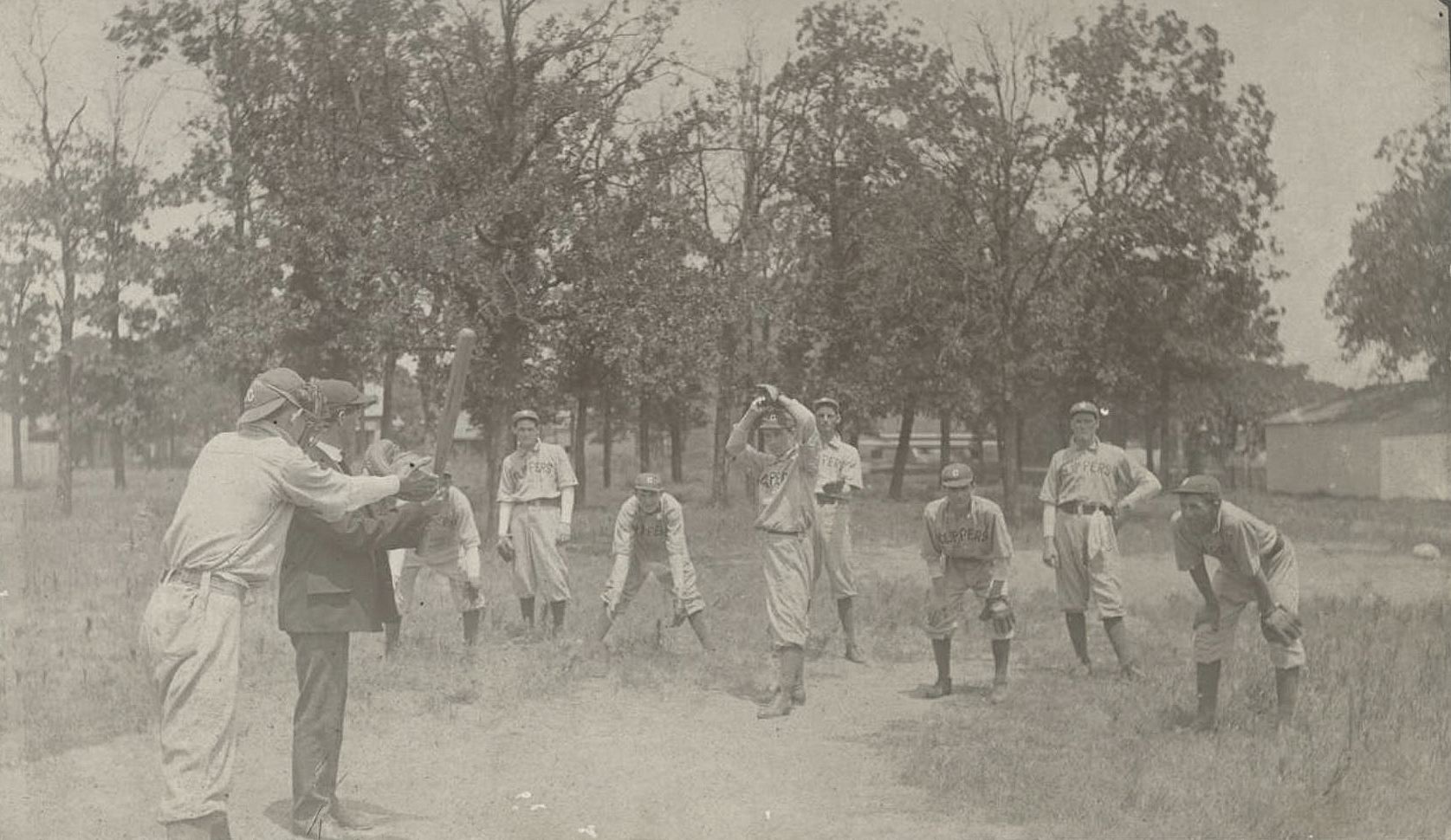
I love this photo from the George W. Cook Collection at SMU’s DeGolyer Library. More at “The Dallas Clippers: Early Dallas Baseball.”

*

mallorys-drug-store_ca-1913_cook-collection_smu

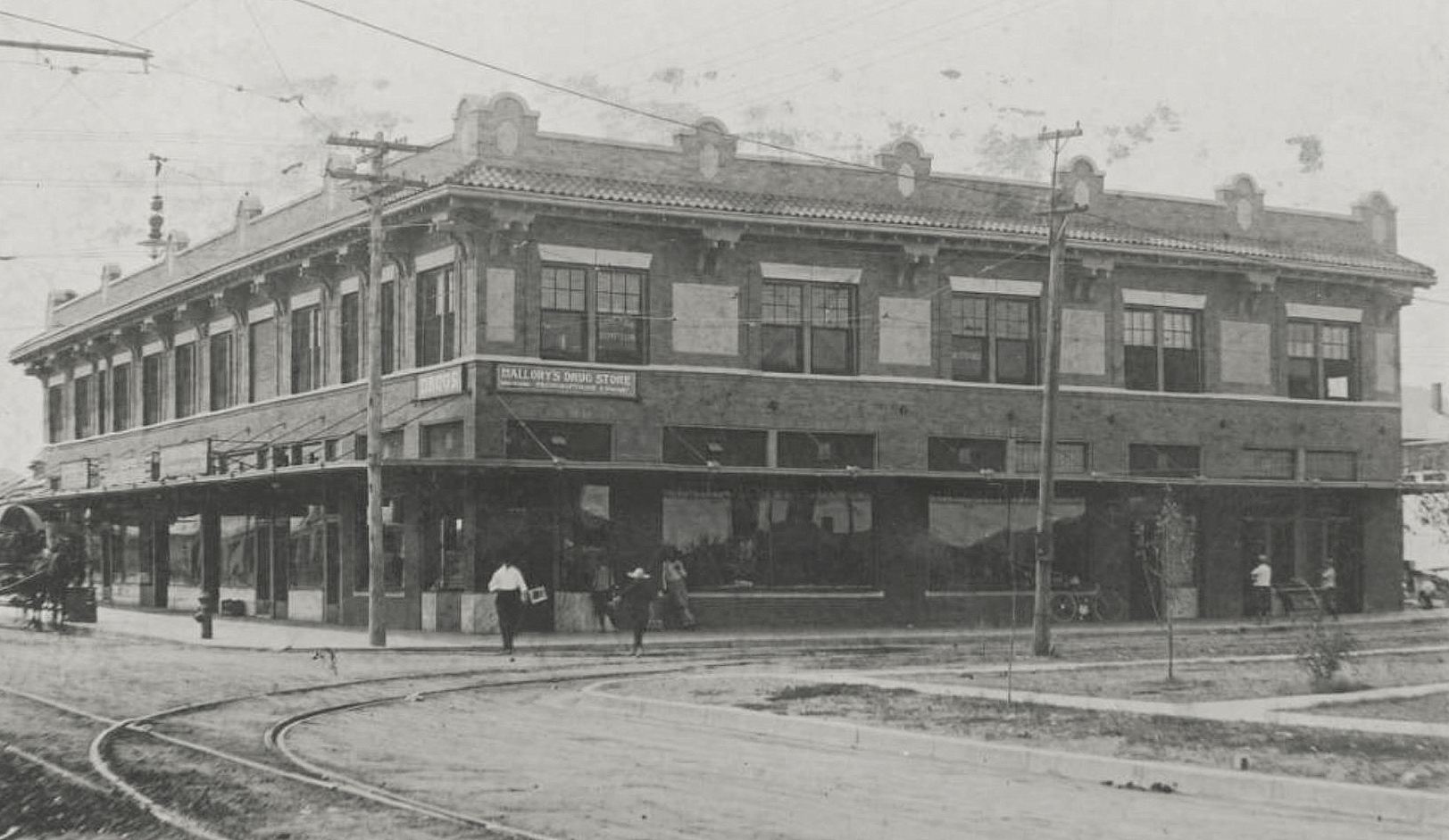
One of my favorite still-standing buildings in Oak Cliff. More about it can be found in the post “West Jefferson and Tyler — 1913.” 

*

bearden_dallas-skyline-late-afternoon-from-stemmons-freeway_litho_1959

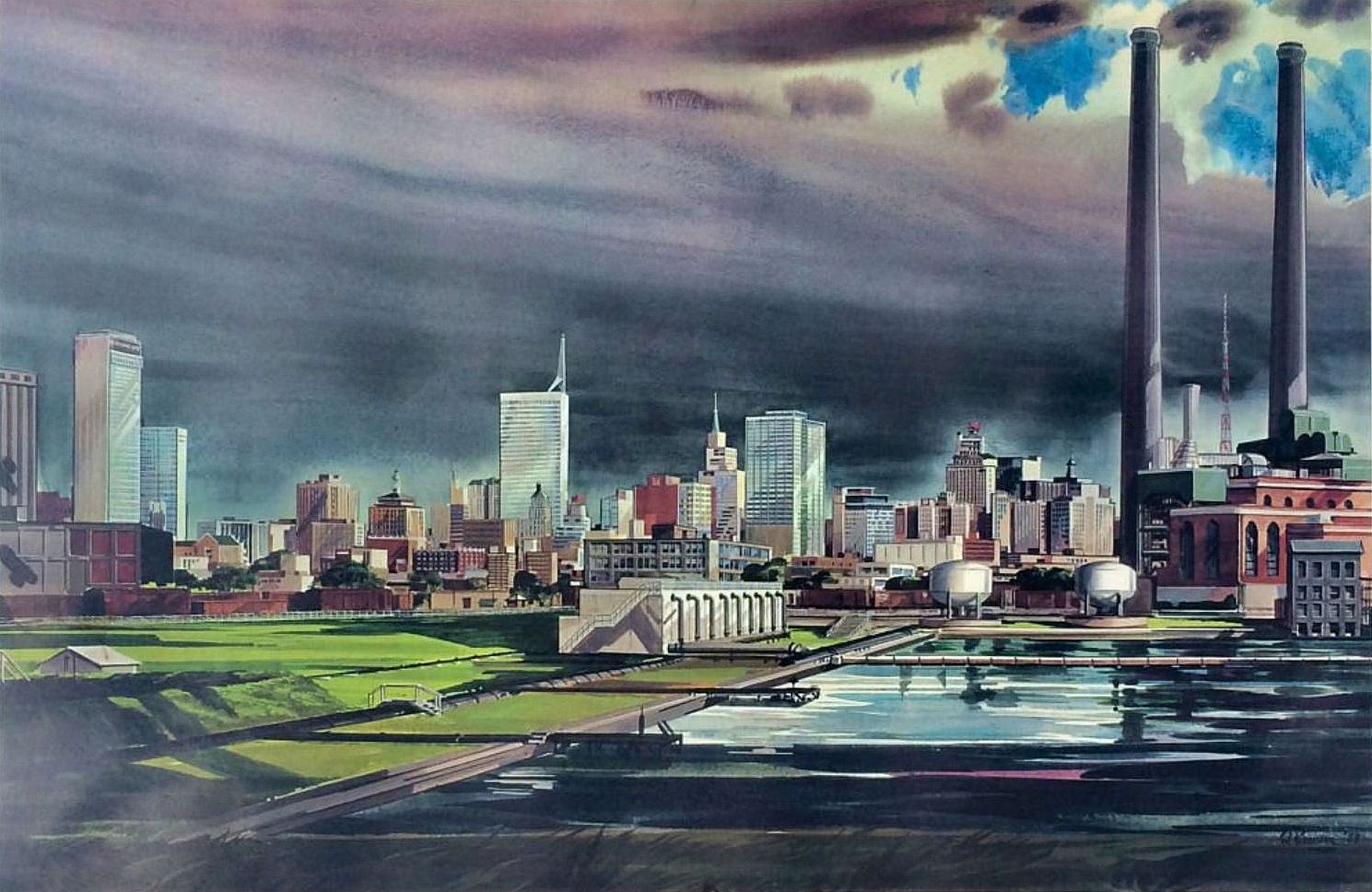
Fantastic lithograph by Dallas artist Ed Bearden — this view from Stemmons looks a lot different now. More info in the post “‘Dallas Skyline: Late Afternoon From Stemmons Freeway’ by Ed Bearden — 1959.”

*

baker-hotel_postcard

This photo was one of the most-shared photos I posted this year — it kind of surprised me, but it’s a great photo of “The Baker Hotel.”

*

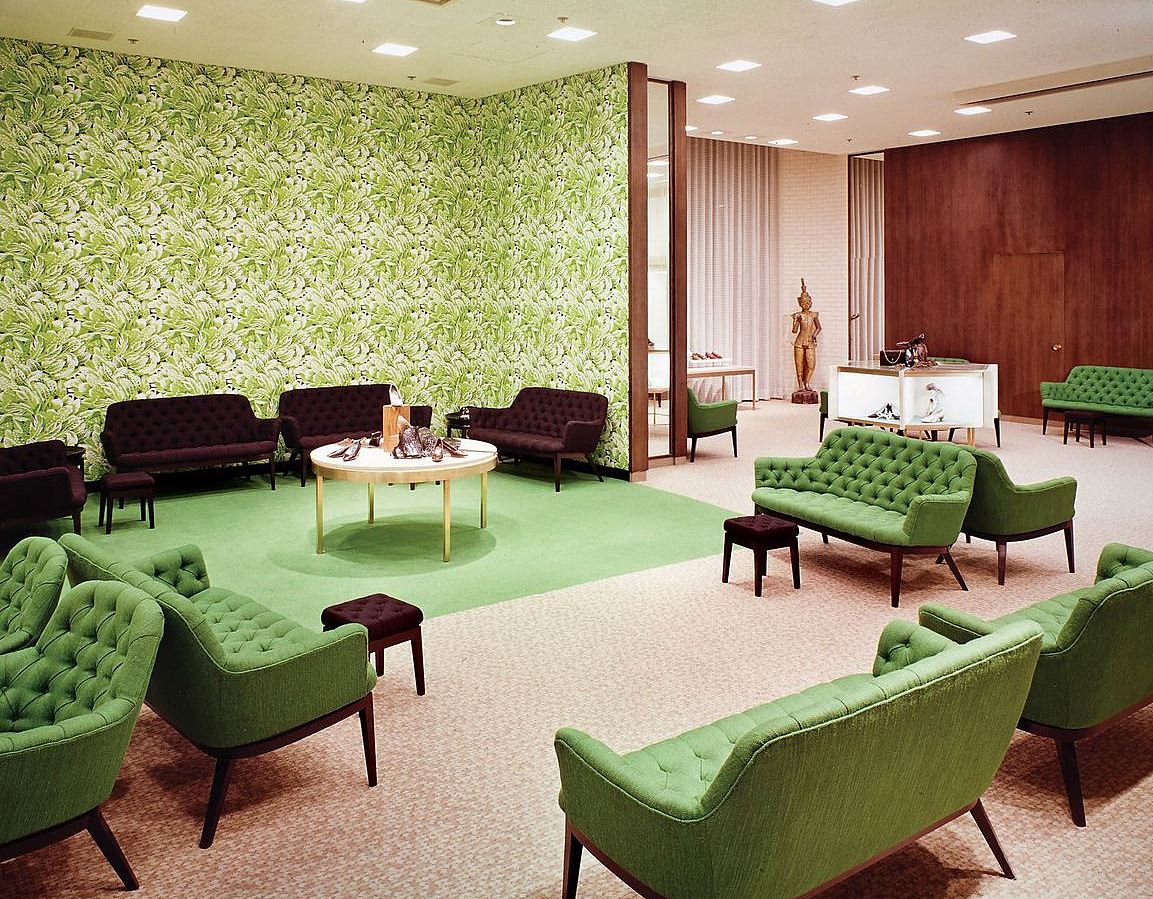
n-m_shoe-salon_1965_nyt-magazine_dec-2016

I love this. “The Neiman-Marcus Shoe Salon — 1965.”

*

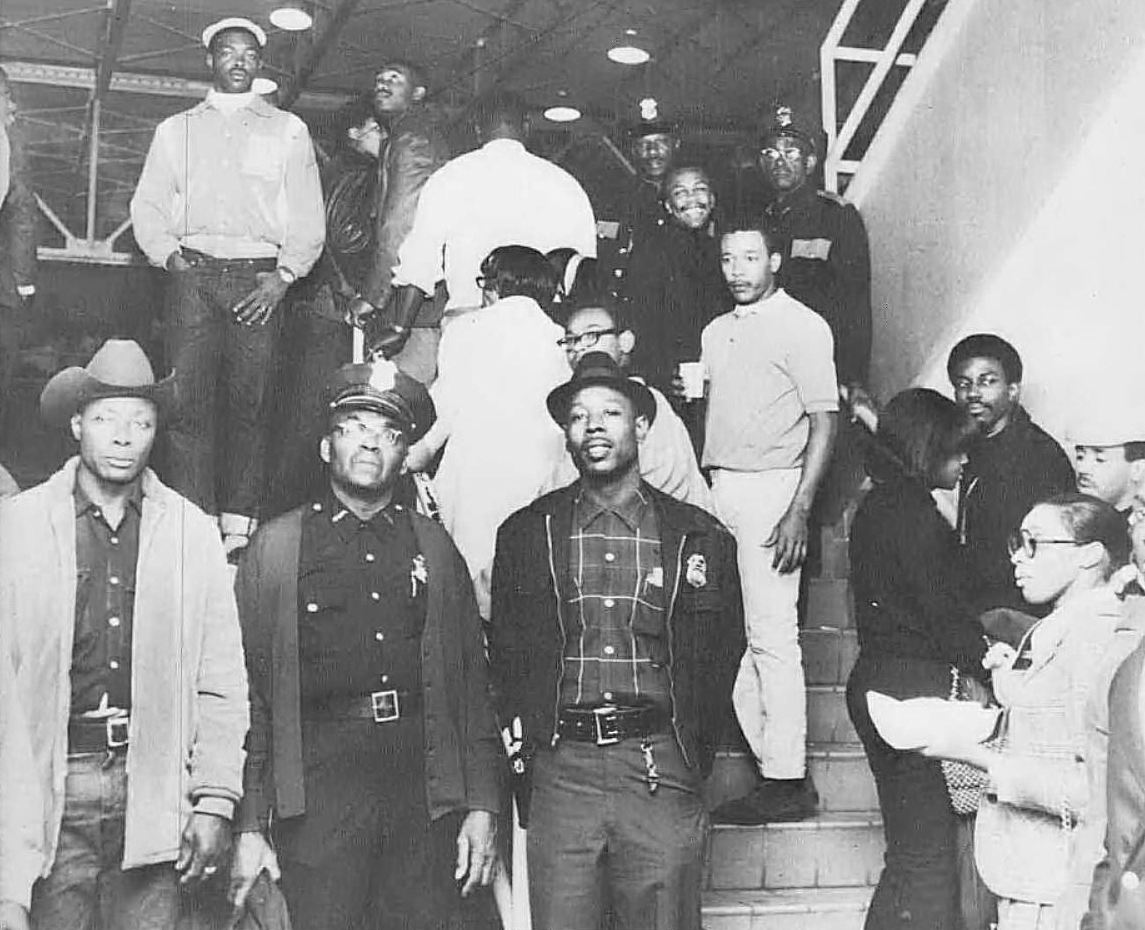
bishop-college_1969-yrbk_campus-security

Campus security at “Bishop College — 1969.” Fantastic.

*

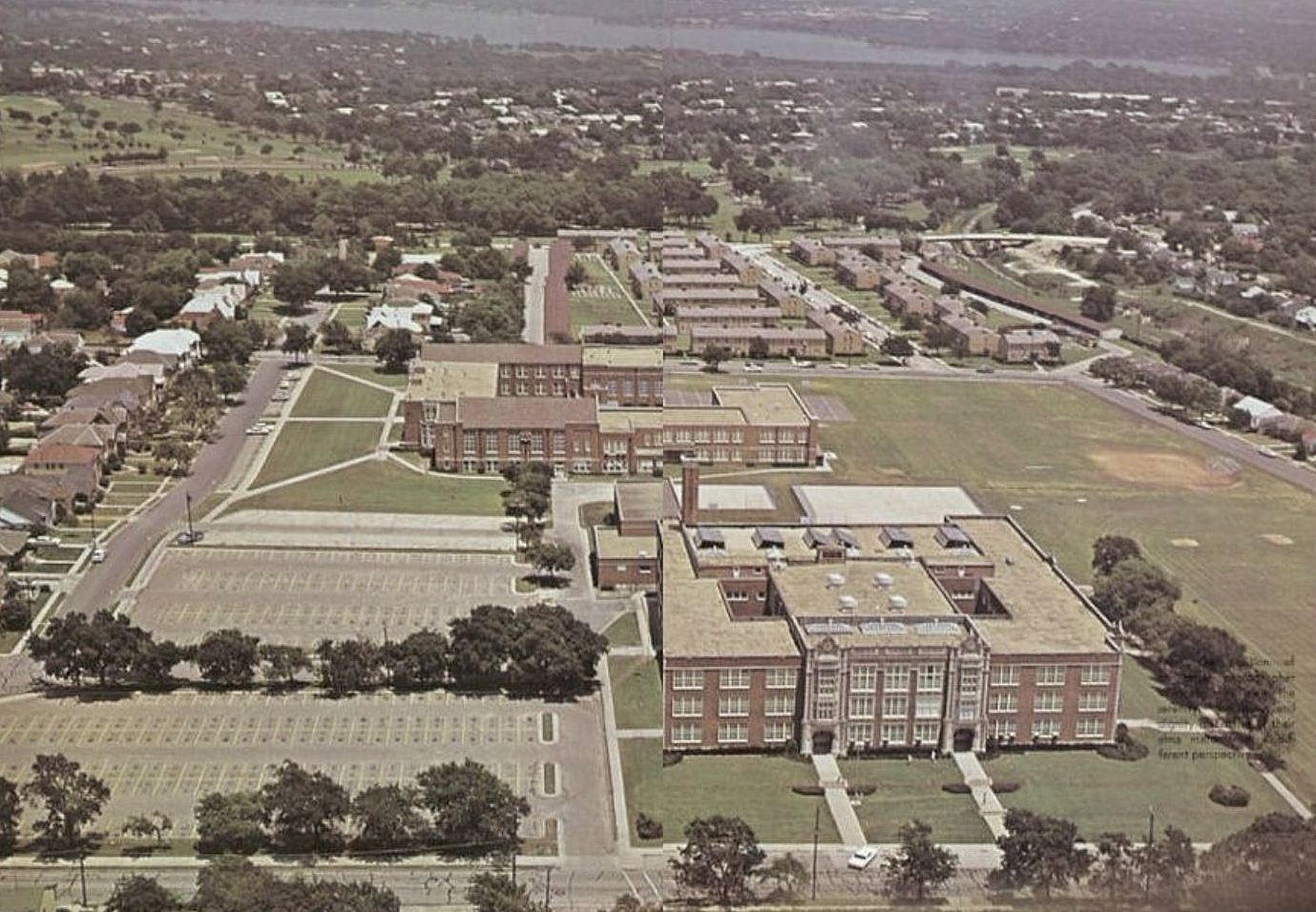
woodrow_1965-yrbk_birdseye

You’ve got to post the occasional photos of the alma maters. I love this photo of Lakewood-area schools J. L. Long and Woodrow Wilson, mainly, I think, because of the surprising sight of White Rock Lake in the background. See the present-day shot, submitted by a drone-owning reader at “Long and Woodrow From Above — 1965.” 

*

jfk-memorial_postcard_portal

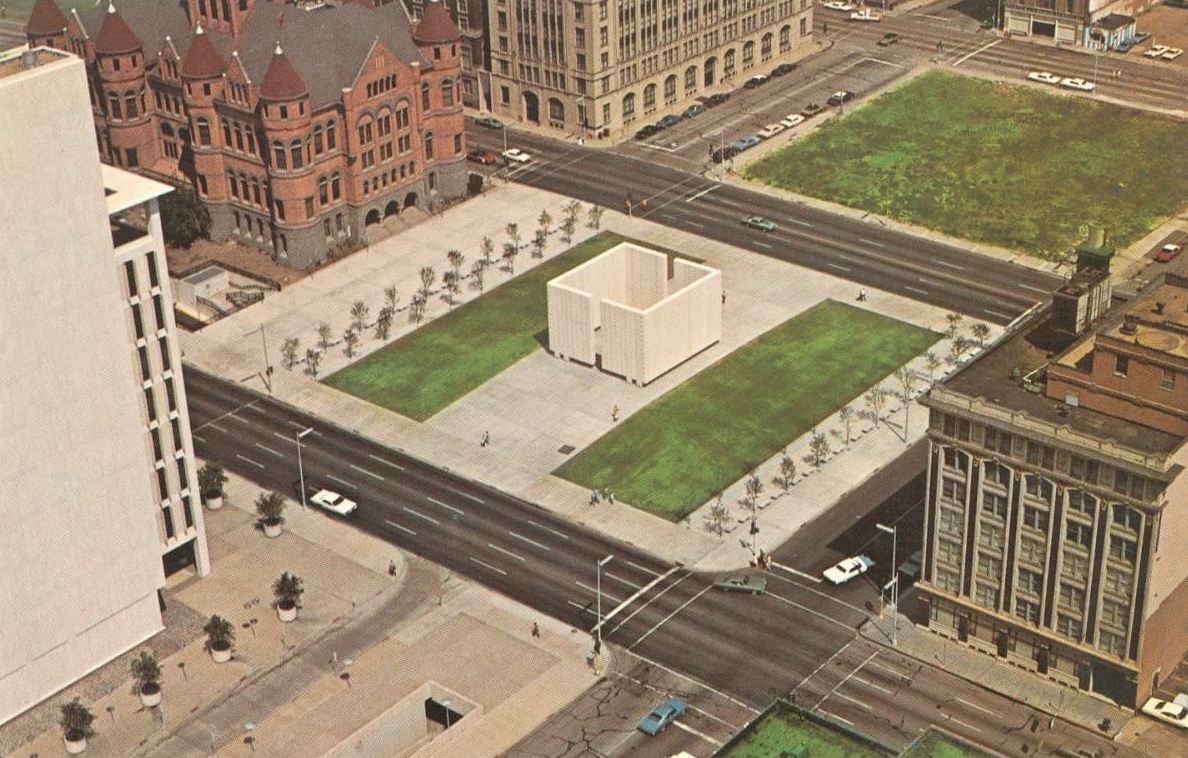
Speaking of familiar sights seen from unusual perspectives, I can’t get over how much I’m fascinated by this postcard of the JFK memorial in its earliest days. From the post “Aerial View of the JFK Memorial — 1970.”

*

dallas-big-d_william-e-bond_business-week-collection_ca1962

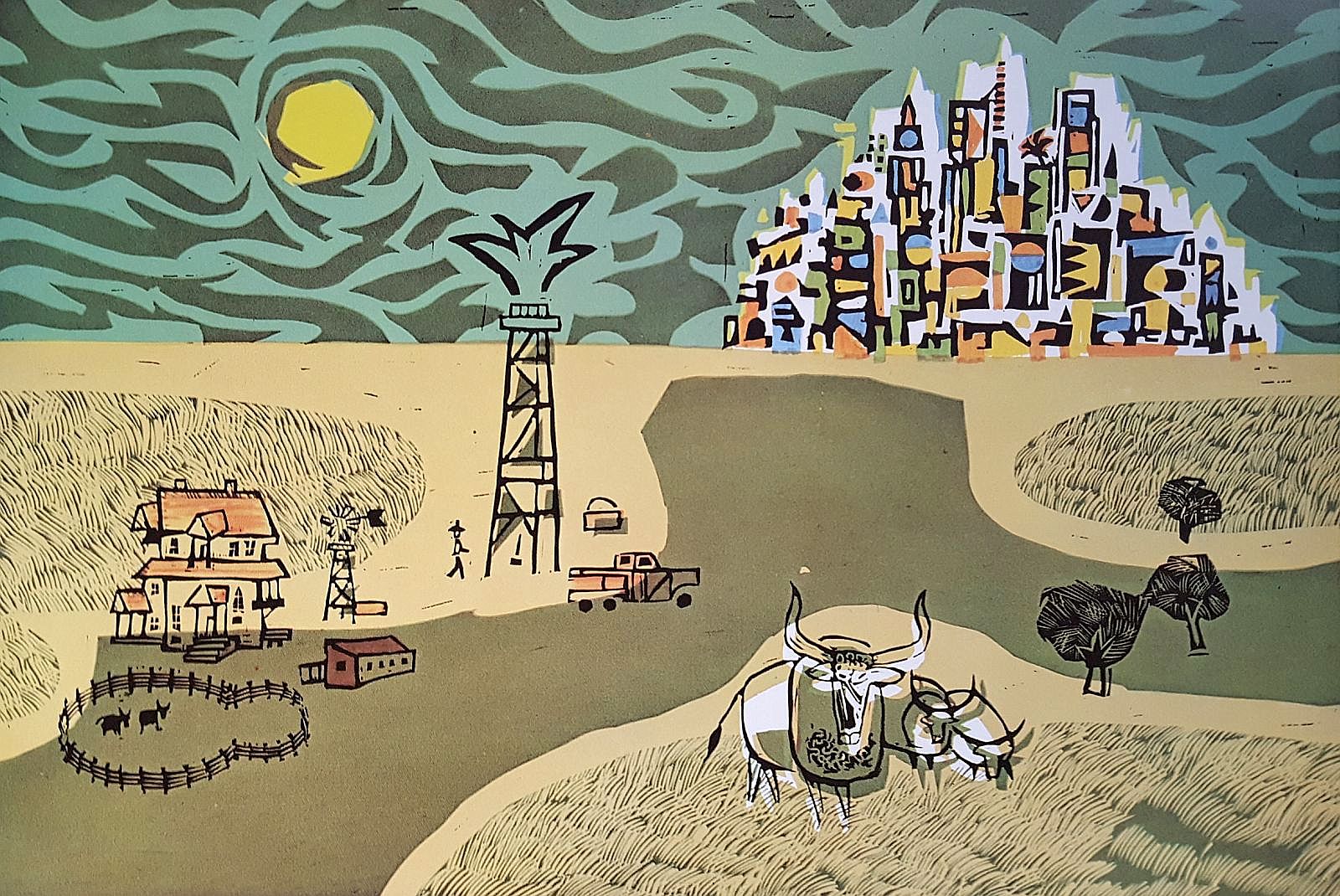
This is without a doubt my favorite Dallas art discovery of the year! “‘Dallas/The Big D’ by William E. Bond — ca. 1962.”

*

downtown-dallas_aia-journal-april-1962

Had to make this one small so it wouldn’t overwhelm the page. Click it1 Lots of info on all the buildings seen in this photo is in the post “The ‘Akard Street Canyon’ — ca. 1962.”

*

FW-zoo_hamilton-hittson_fawn_062937_UTA

Okay, so this is Fort Worth, but, hey — close enough! Let the cuteness-overload wash over you as you look at adorable animals big and small in the post “Cowtown Extra: Fort Worth Zookeeper Ham Hittson and His Forest Park Friends.”

*

wfaa_george-dahl_ed-bearden_postcard

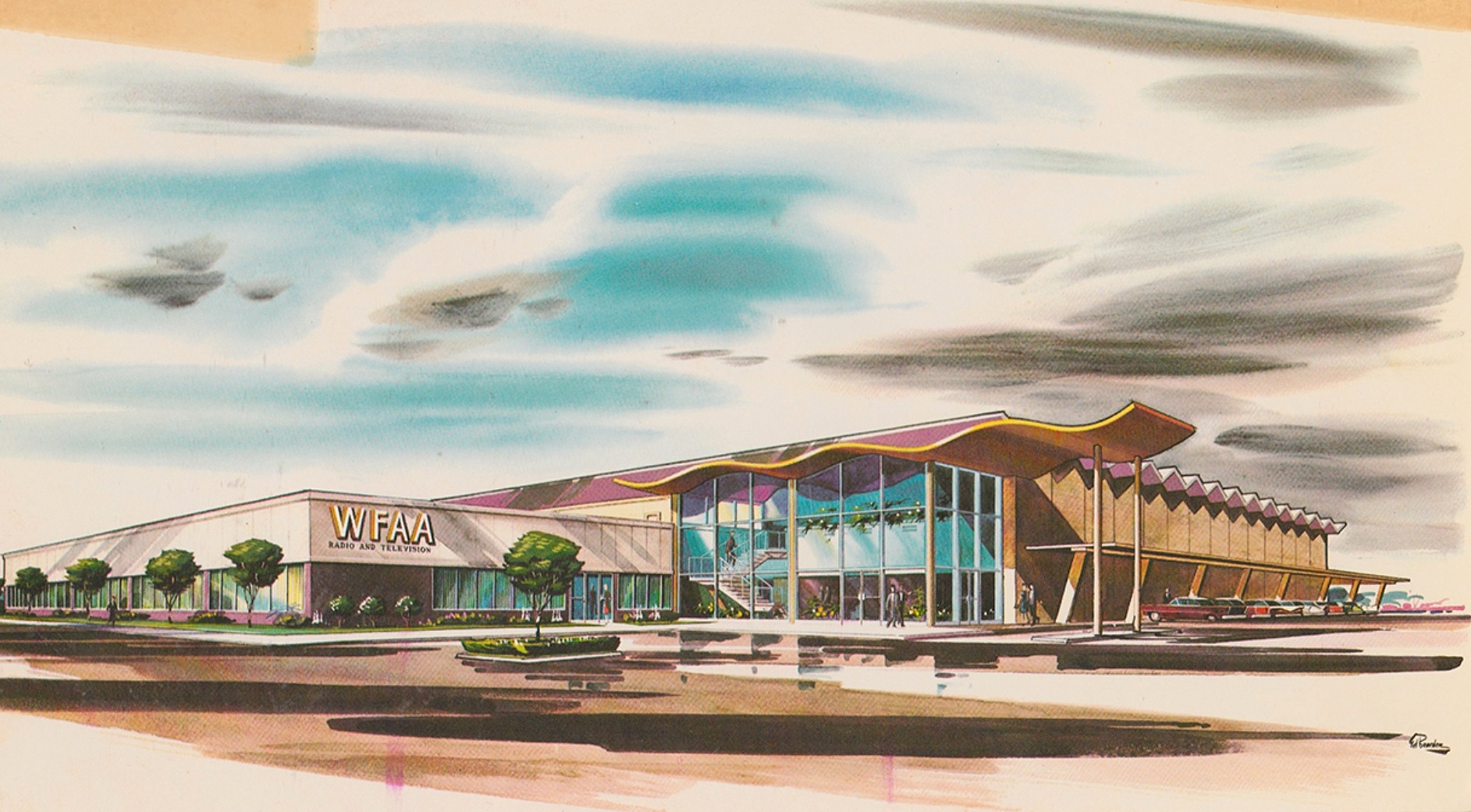
The more I see of Ed Bearden’s work, the more I love it. Here he captures George Dahl’s always-cool mid-century-modern sleekness. “The WFAA Studios, Designed by George Dahl, Rendered by Ed Bearden — 1961.”

*

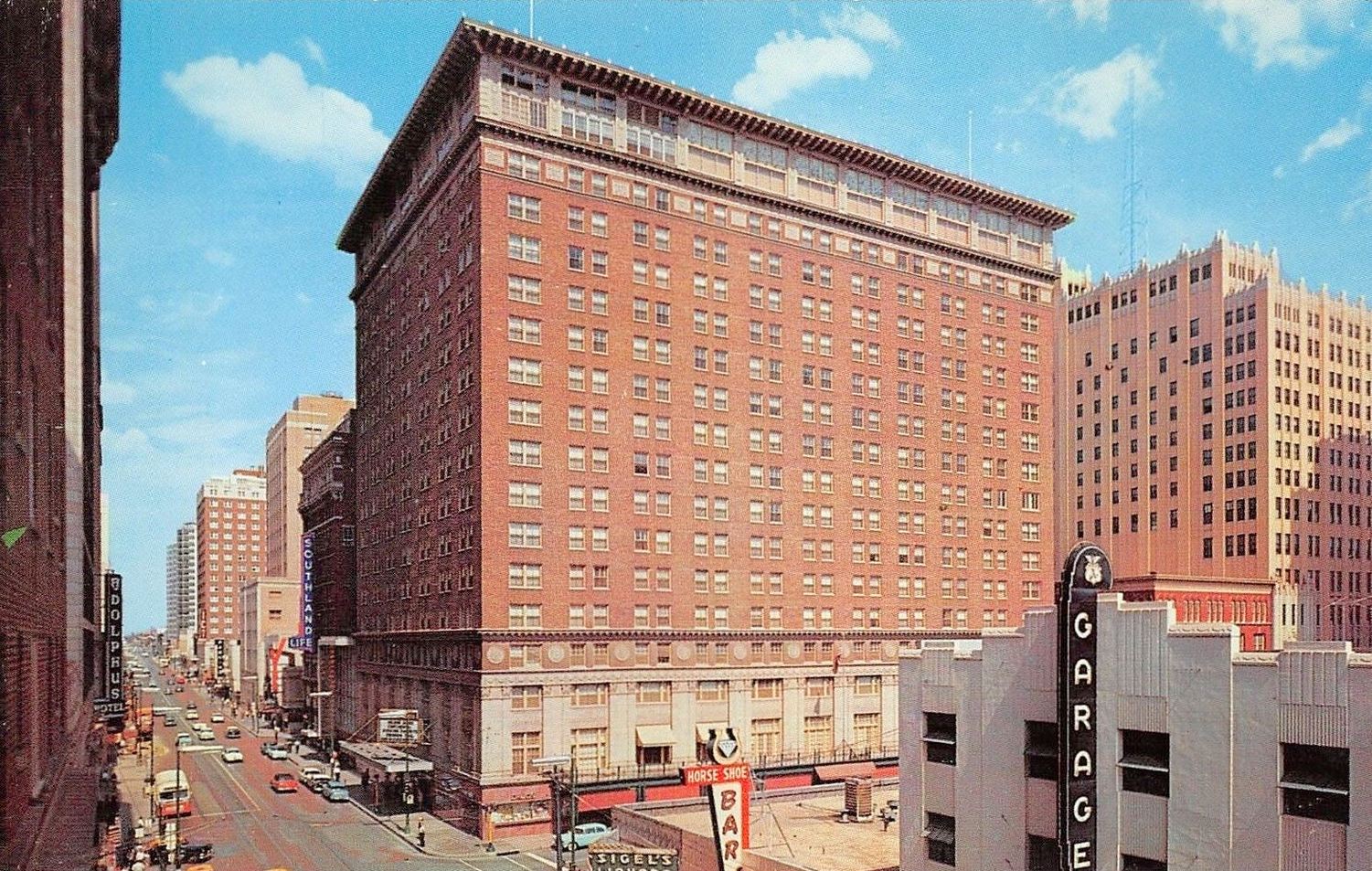
commerce-street_walgreens_adolphus_1957_ebay

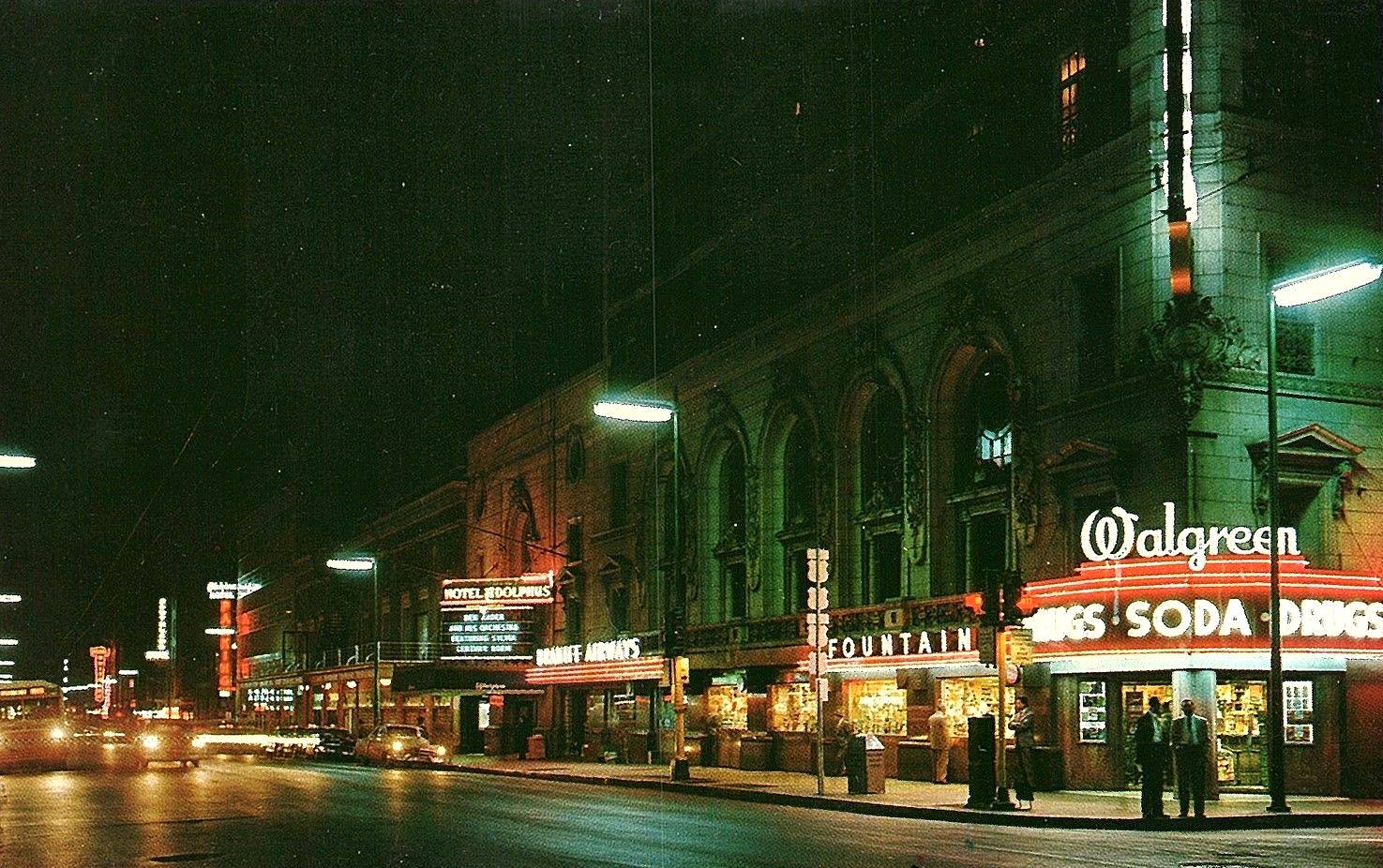
This postcard view of the Adolphus block at night is one of my all-time favorite photos of downtown Dallas. It would be nothing without that heart-palpitatingly wonderful Walgreens neon at the corner of Commerce and Akard. More at “Nighttime on Commerce Street — 1957.”

*

gill-well-sanitarium_dmn_011307_photo

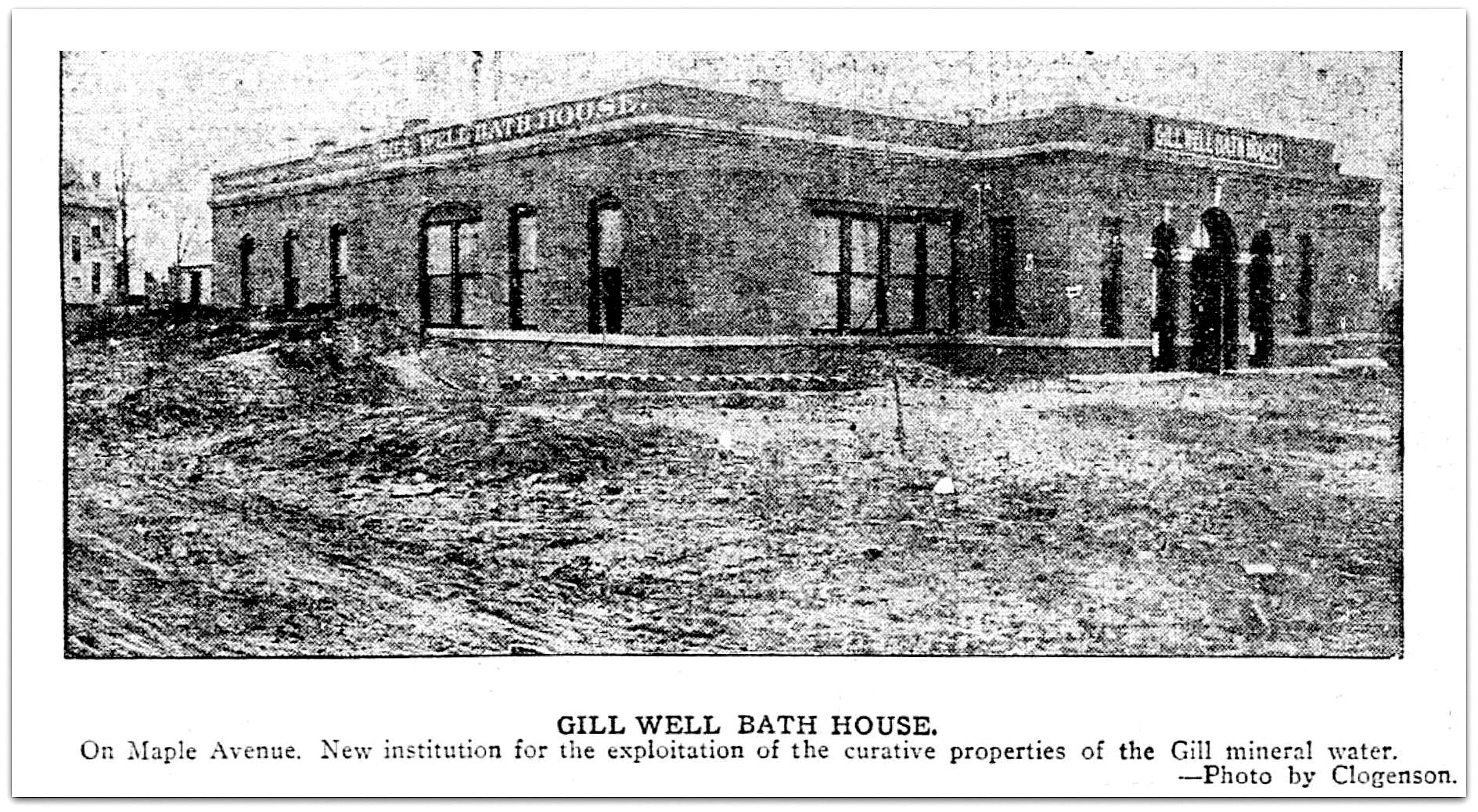
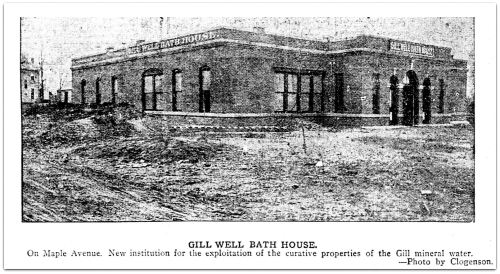
The image-quality of this newspaper photo leaves a lot to be desired, but this is the photo that most excited me this year. I spent an incredible amount of time researching the Gill Well, and I was really surprised by how few photos I could find. Finding this 1907 photo of the Gill Well Bath House was pretty damn thrilling. Thank you, Clogenson! From the post “The Gill Well.”

*

ervay-north-from-commerce_det_052417_bosse

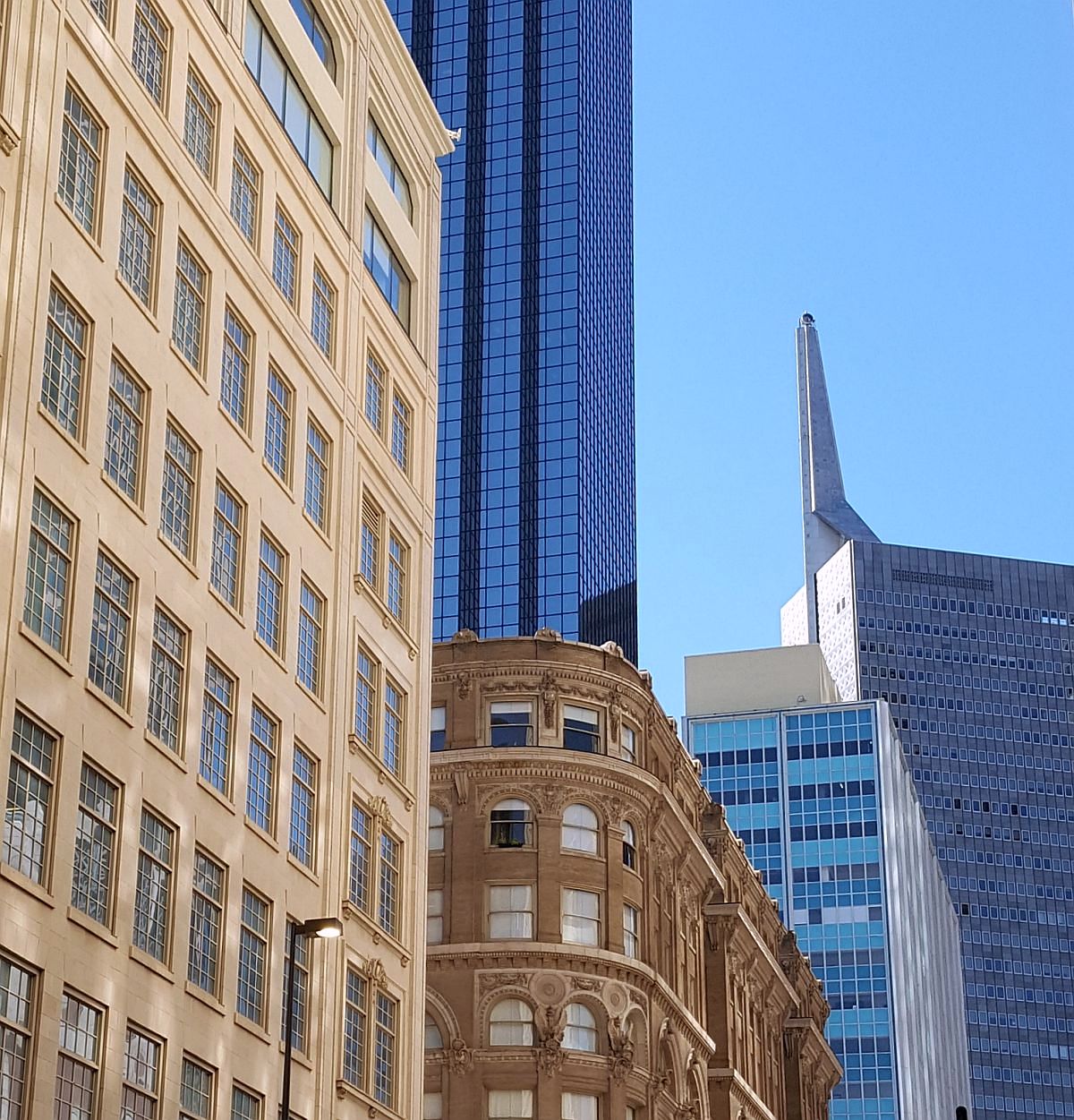
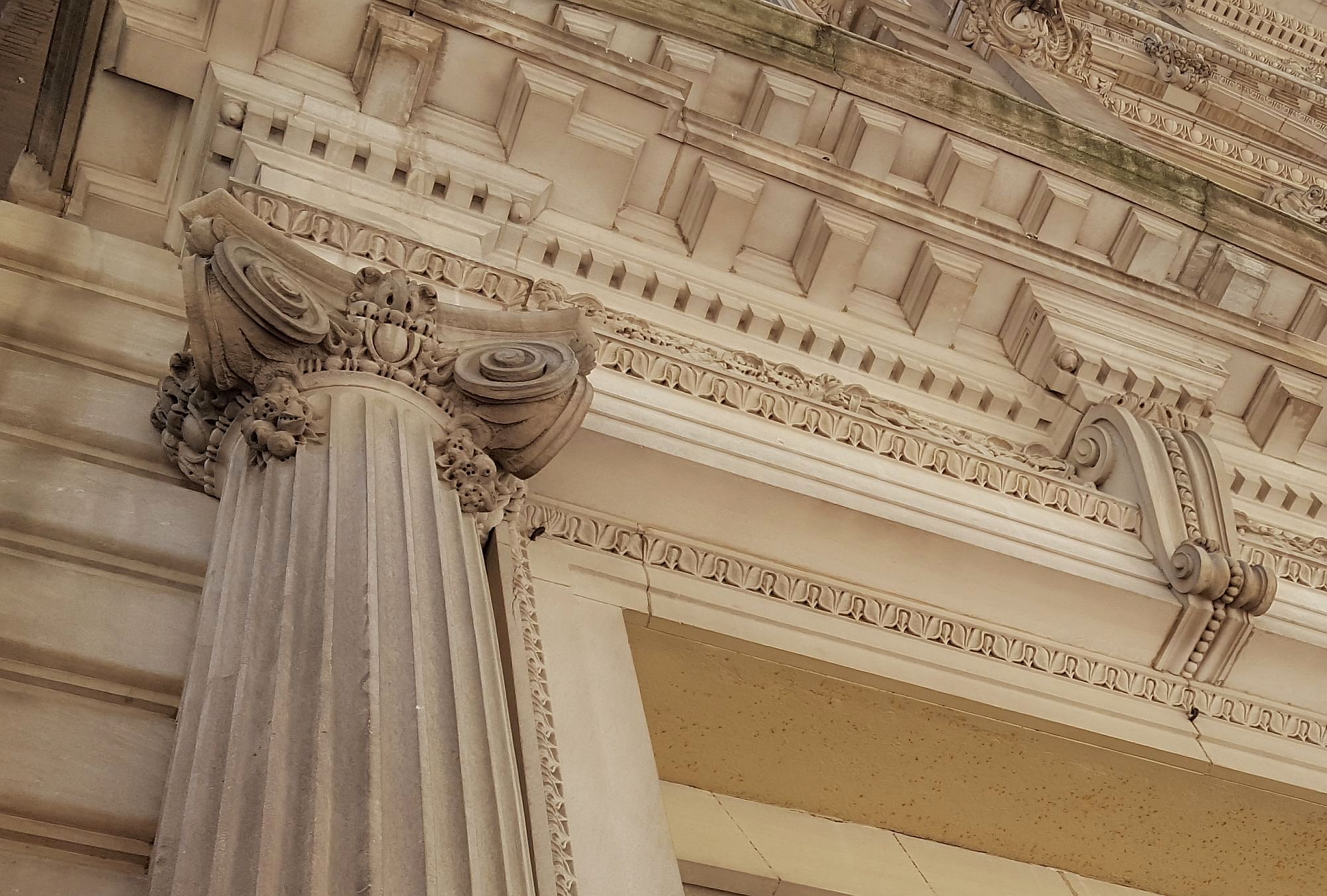
I actually took a few photos myself, and there are a couple I really love — like this one which captures five of Dallas’s most recognizable buildings in one shot. Architecture-a-rama. It is from the post “Downtown Dallas, Last Week,” which also includes the photo below — a view of the Wilson Building you might not have seen before.

wilson-bldg_detail_052417_bosse

*

st-jude-chapel_la-virgin_det_052417_bosse

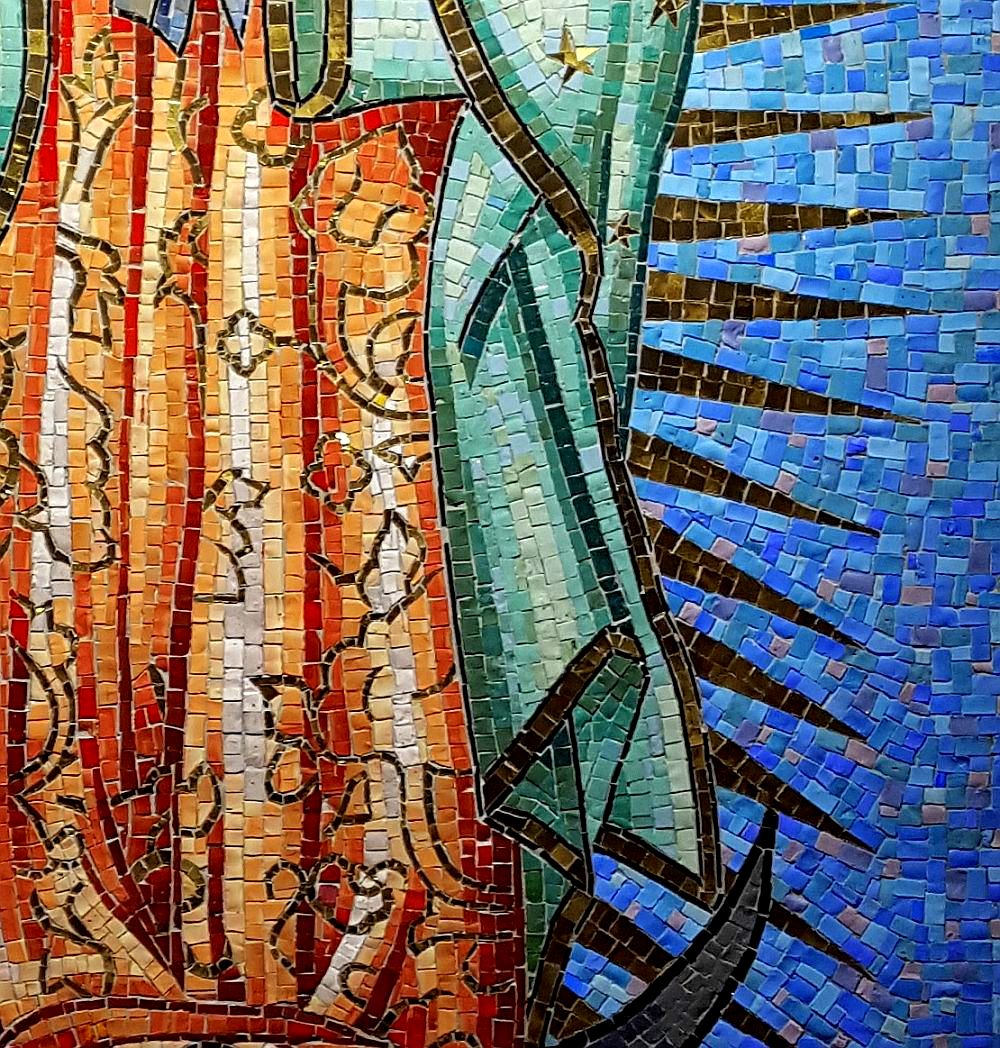
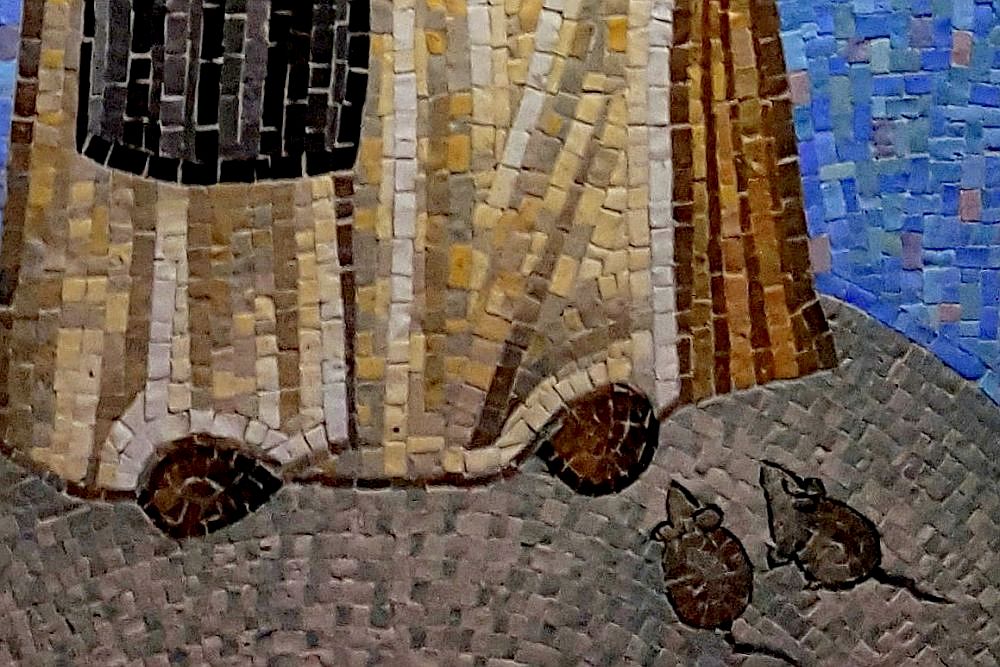
And lastly, two more of my own photos, taken at the St. Jude Chapel, which is filled with mosaics. The one above shows a detail of the Virgin of Guadalupe, and the one below shows a detail of St. Martin de Porres (mice!). More at “Mosaic Restoration at Downtown’s St. Jude Chapel.”

st-jude-chapel_st-martin-de-porres_mice-det_052417_bosse

***

Sources & Notes

It’s been a visually-satisfying year!

See all three 2017 “Best Of Flashback Dallas” lists here.

See all Flashback Dallas Year-End lists — past and present — here.

*

Copyright © 2017 Paula Bosse. All Rights Reserved


A Bird’s-Eye View to the North

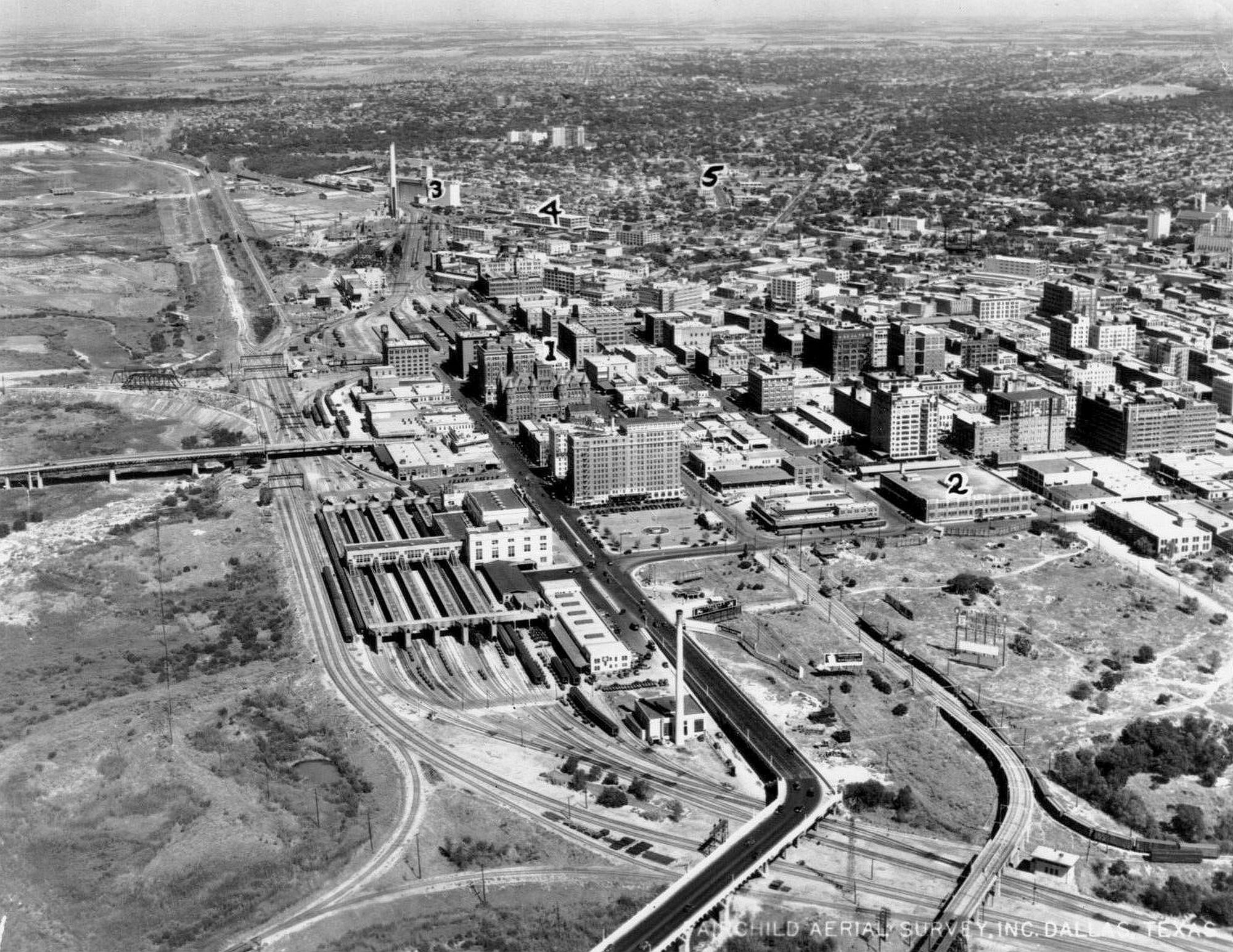
downtown_fairchild-aerial-survey_lgAs the crow flies… (click for much larger image)

by Paula Bosse

This is a great view, produced by the Fairchild Aerial Survey Co., taken sometime between 1925 (when the Ferris Plaza waiting station was built) and 1934 (when the land between the Trinity and the courthouse began to be cleared to begin construction of the “million-dollar project” which would eventually be known as Dealey Plaza and the Triple Underpass).

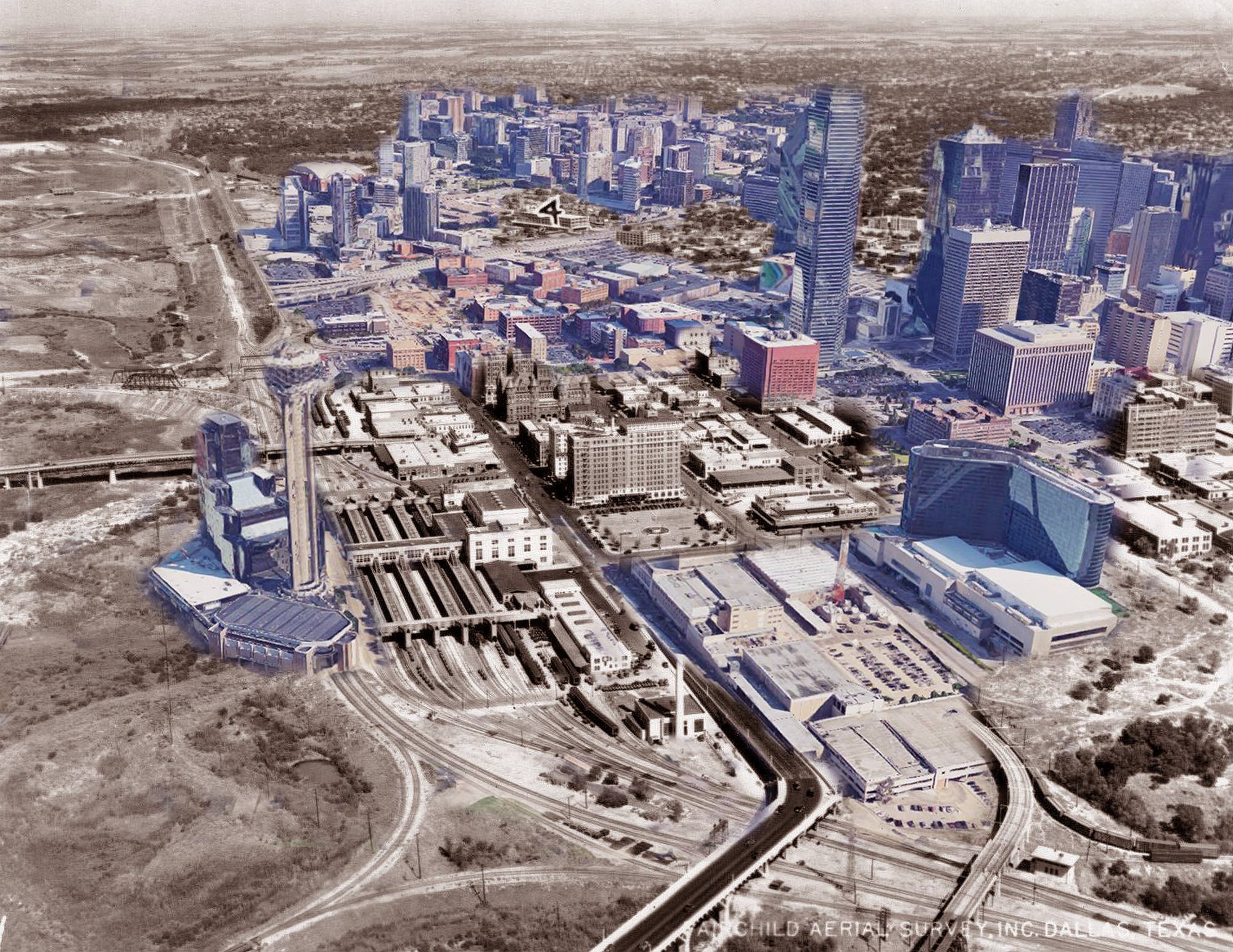
UPDATE: Brian Gunn posted this fantastic now-and-then overlay on the Dallas History Guild Facebook page. I love this. Thank you, Brian!

downtown-aerial_fairhchild-survey_brian-gunn-overlay

These images are huge. Click ’em!

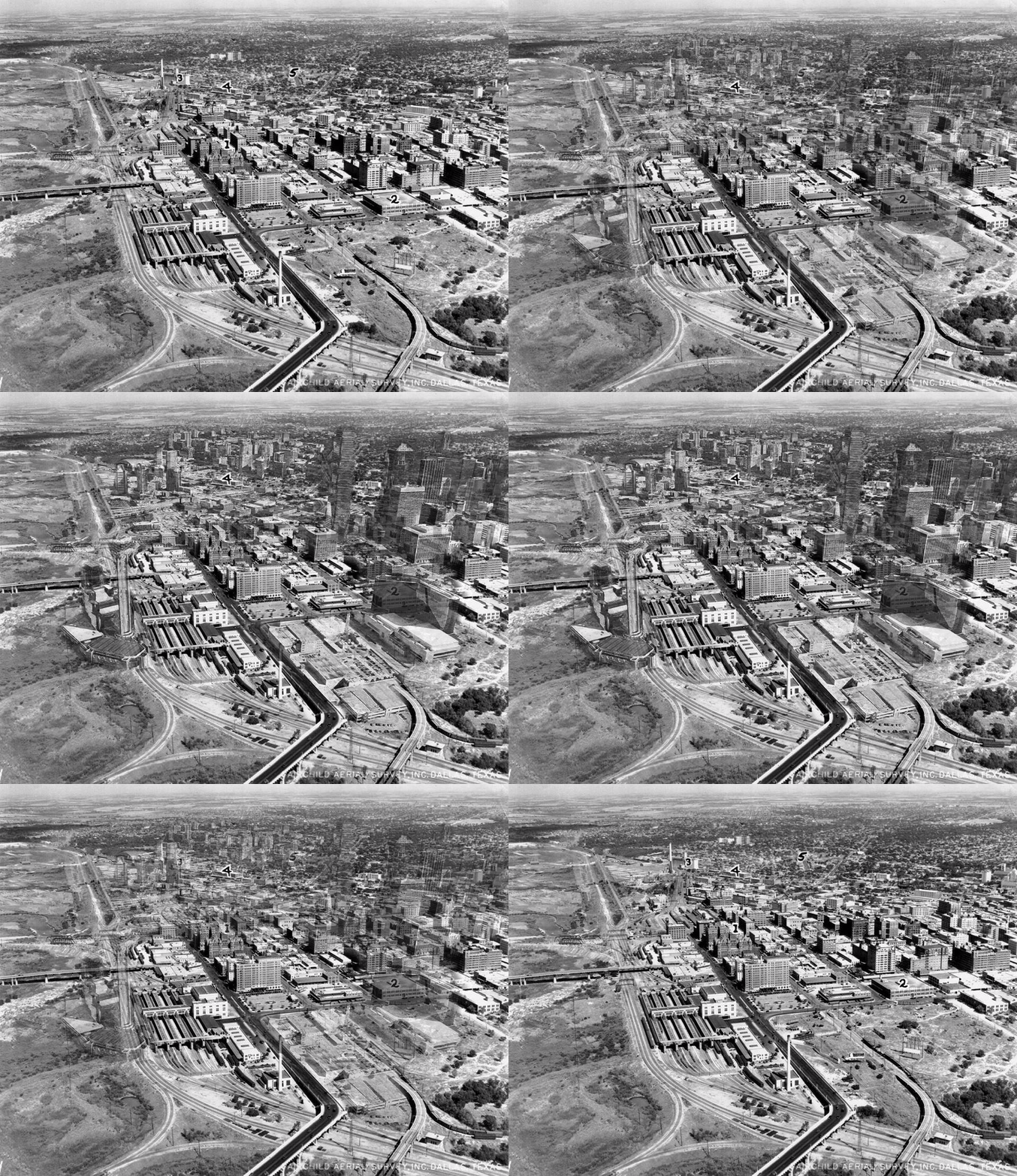
UPDATE #2: Such participation from Flashback Dallas readers! Eric Hanson has now animated Brian Gunn’s overlay. Watch Dallas shoot up! Thank you, Eric! (Click GIF to see it slightly larger.)

eric-hanson_GIF-overlay

***

Sources & Notes

Photo found on eBay.

*

Copyright © 2017 Paula Bosse. All Rights Reserved.


KRLD News Crews, At the Ready

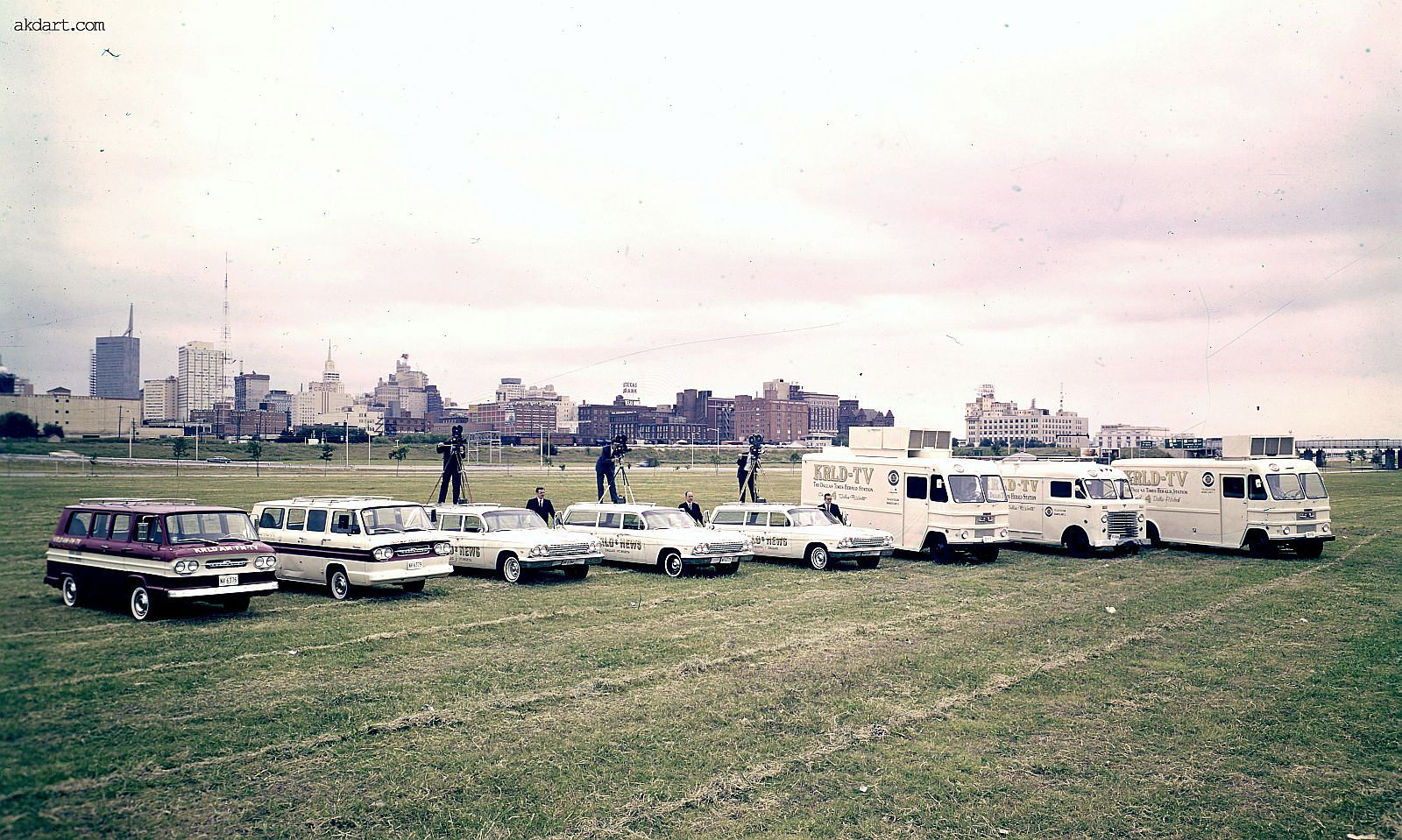
krld_news-crews_early-1960s_akdartThey mean business: they’re wearing suits and ties…

by Paula Bosse

Early-’60s-era KRLD radio and TV mobile news crews are seen above, showing off their fleet and ready for breaking news. Behind them, the Dallas skyline, seen from an unusual vantage point: the Trinity levees. See this photo really big here, and explore the skyline, from the Republic Bank Tower on the northern edge of downtown, to the Dallas Morning News building on the southern edge.

***

Sources & Notes

Photo is from an interesting collection of “very old pictures from KRLD radio and TV,” presented on the website akdart.com.

*

Copyright © 2017 Paula Bosse. All Rights Reserved.

State Fair of Texas Midway — 2017

midway-entrance_sfot_night_100417The State Fair of Texas midway never gets old… (click for larger image)

by Paula Bosse

I haven’t been to the State Fair of Texas for several years, so I took a trip out to Fair Park this past Wednesday to see what’s new.

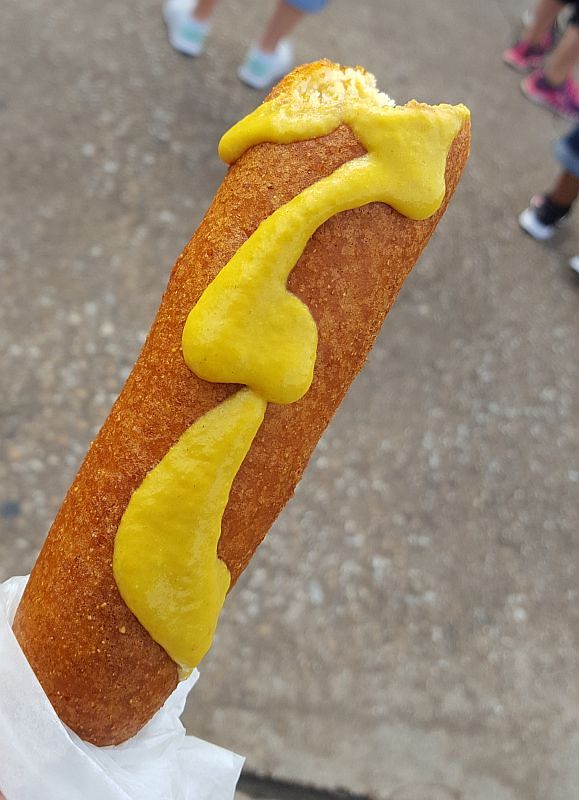
Food. The only thing I ever really want is the traditional Fletcher’s corny dog, and I’m happy to report they’re as good as ever.

corny-dog_sfot-100417

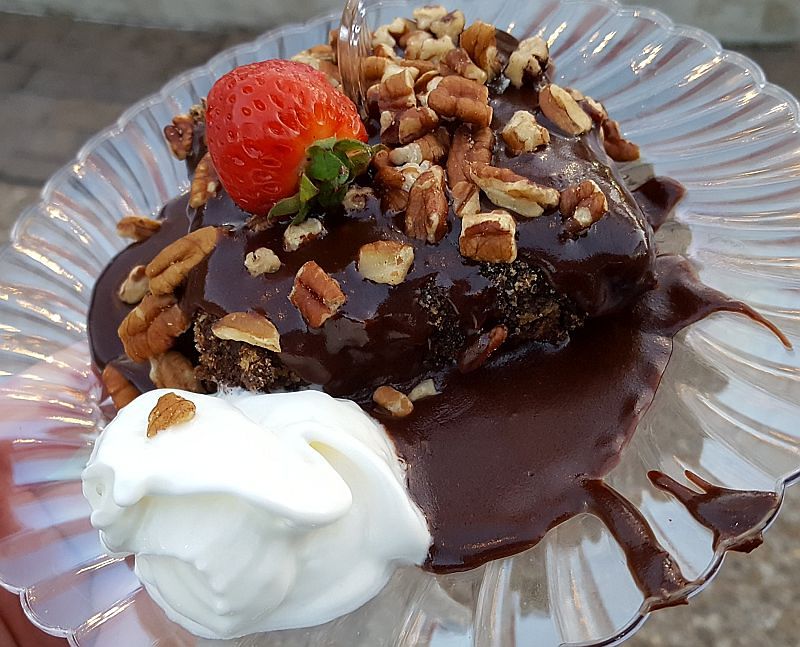
I also tried the Fried Texas Sheet Cake which was — and I can’t believe I’m saying this — too sweet, and just … too much. A bite would have been plenty. The topping of chocolate syrup and pecans was the best part. Maybe someone should offer a bowl of just that. …And then fry the whole thing — bowl and all. I’d probably try it.

fried-tx-sheetcake_sfot_100417

When I saw the sign for “Fried Chicken Skin” I had to try it. I guess it’s something you either really want, or it’s something that makes you recoil in horror. I really wanted it. I was expecting more of a battered-Church’s-fried-chicken experience, but I don’t think there was any batter at all. I still liked it, but it could have been a lot more mouthwatering. It needed a bit more heft. (Speaking of fried skin — there’s a phrase I’ve never uttered — why aren’t there chicharrones at the fair? Done right, those things are incredible. Isn’t pork belly still a thing?) (And someone really should do battered fried chicken skin.)

fried-chicken-skin_sfot_100417

It might have been healthier had I just swallowed the cute Big Tex earrings ($10, zero fat grams), which I almost went back for. It takes a special kind of person to be able to pull those off, and I’m afraid I’m not that whimsical. But I bet they make a great conversation-starter and help break the ice at parties.

big-tex-earrings_sfot_100417

Everything was remarkably clean. I mean really clean. …Freakishly clean. This is not the grimy, dirty, cigarette-butt-laden fair I remember as a kid, and I have to admit, I kind of missed the grime and trash. Also, I don’t remember the plush toys being so remarkably colorful. My retinas will never be the same. Click the photo below to get the full neon blast of color.

midway_prizes_sfot_100417

Speaking of things I miss, I also miss the seediness of the fairs from my childhood in the ’70s (certainly the seediest decade in modern times): the unkempt carnival barkers who never sounded like they were from Texas, the bored ride operators going about their repetitive jobs with a cigarette hanging from their mouth, the half-eaten candy apple stuck to the asphalt, and, yes the side shows. Without doubt, I think my favorite thing about the annual fair was seeing the huge banners emblazoned with vivid images of freaks and oddities — those banners were works of art and sheer advertising genius. I never wanted to see the shows, but I loved those banners, and I loved listening to the raspy voices of the going-through-the-motions barkers. Now? I saw a teeny booth along the midway wherein was what was purported to be the world’s smallest horse (yawn), and then there was the exhibit below featuring what appeared to be nothing more than a two-headed rattlesnake and a couple of two-headed turtles inside a little building about the size of a portable garden shed. But a kid will always be fascinated by anything with two heads. I realize my interest in two-headed creatures isn’t what it used to be, and I also realize that the day of the brilliant freak show banner art has come and gone.

midway_alive_sfot_100417

When I was a kid, my favorite “ride” was always the German Funhouse. I did see one funhouse, which did not seem to be specific as to country of origin. These haunted houses get high marks for decorative impact. This is what you want to see at a state fair!

haunted-house_sfot_midway_100417

scary-park_sfot_midway_100417

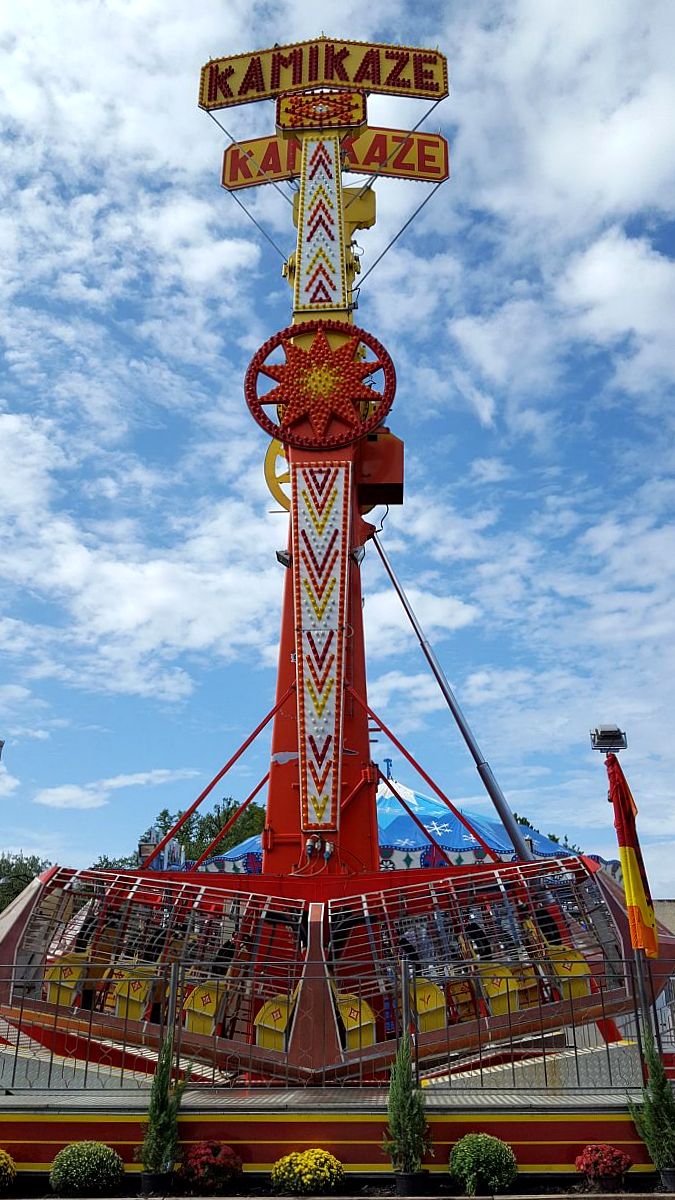
Incidentally, it will cost you 6 coupons to experience the full gory glory of “Scary Park” — that’s HALF the price of one order of fried chicken skin! Seems like a pretty good deal. There are some “extreme” rides that will cost you 150 coupons. ONE HUNDRED AND FIFTY COUPONS. That’s $75. I watched one of these rides, which began with two teenagers being strapped into some sort of horizontal harness. The second step was the signing of the waivers. Then the boys were raised way, way up and then dropped and flung across the sky from a height which makes me queasy just thinking about it. They swung back and forth a few times and were then lowered to terra firma, no doubt thrilled and nauseous. That makes a whirl on the quaint Kamikaze seem like a leisurely stroll around the neighborhood after a light meal.

kamikaze_sfot_midway_100417

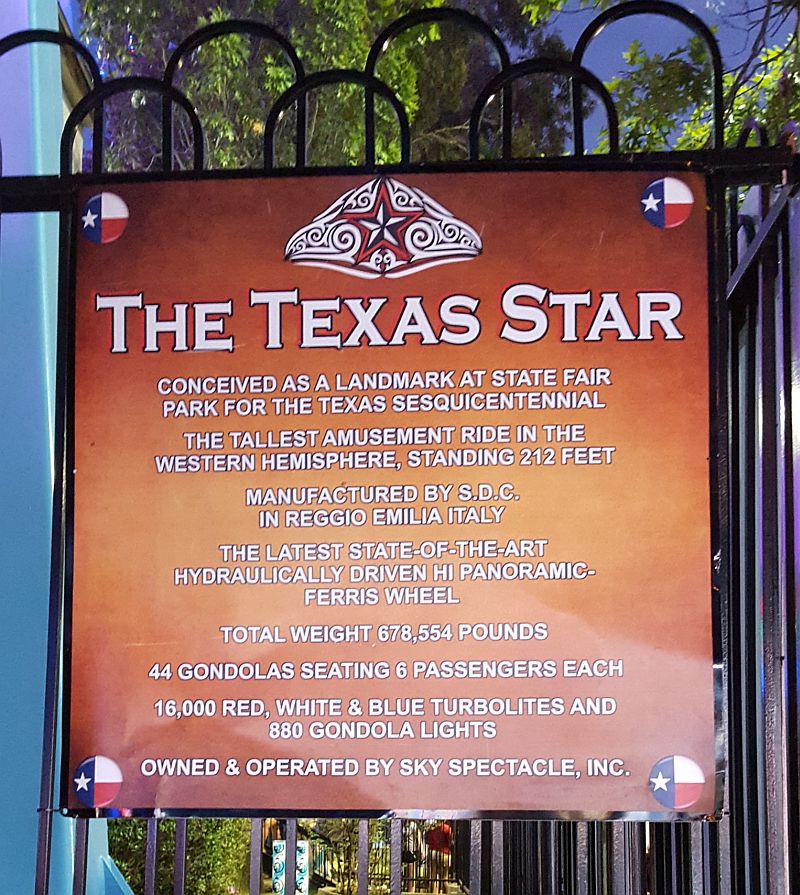
The Texas Star ferris wheel is pretty impressive and deserves a better photo than this, but look at the ground — you could eat off that!

texas-star_sfot_100417

In case you ever find yourself on Jeopardy and the category is “Amusement Park Rides,” this might be helpful.

texas-star_ferris-wheel_history_sfot_100417

I don’t know how many Fletcher’s stands there are at the fair, but this one on the midway is certainly the brightest. (And if you say “corn dog” in my presence I will be forced to correct you….)

fletchers-corny-dog-stand_sfot_midway_100417

My favorite sign at the fair was this one, at the beautiful entrance to the beautiful Hall of State: “NO FOOD, NO DRINK, NO BALLOONS.” Don’t even think about it.

hall-of-state_no-balloons_sfot_100417

And look at Hall of State at night. Nary a balloon in sight.

hall-of-state_illuminated_night_sfot_100417

I was actually working in the Hall of State the day I took these photos, so I had a short walk around the park right after it opened (that corny dog was my breakfast!) and a longer walk around the midway at night. A few thoughts:

  • I’m the only person who wishes it weren’t quite so clean.
  • Neon Big Tex is way better than “new” post-flambé Big Tex. Everyone complains about the new Big Tex, and I’m one of them. There’s a new kid in town, Tex, and my allegiance is now firmly with Neon Big Tex, the old Centennial Liquor sign featuring a neon-outlined Big Tex recently planted in Fair Park.
  • I never liked the nightly parade as a kid, but I really enjoyed it this year. The floats were attractive, the cowboy on stilts and the unicyclist on a stuffed pony were fun and goofy, and the Carter High School band was really, really good (and brought memories of my high school marching band days back with a vengeance). Also in the parade were several policemen on horses. I wondered what happened when a horse would leave its … um … byproducts behind them in the (meticulously clean) street, and then I saw a policeman riding behind in a golf cart, with a shovel strapped to the side and a large receptacle in the back. I wonder if the officers draw straws before the parade to see who gets stuck with shovel-duty?
  • I did not visit any buildings. I saw no canned peaches, no automobiles, no butter sculptures, no livestock, no miracle mops, no pig races. I’ll have to leave those for next time.

parade_neon-big-tex_lasso-stilts_sfot_100417

The best thing about the fair is that everyone is happy — especially the children, who are often over-stimulated and beside themselves with excitement — and it reminds me how much I used to look forward to my annual visit.

Seeing the fair in the daytime and at nighttime are two completely different experiences. Daytime in general is overrated. Always choose nighttime!

super-midway_sfot_100417

***

Sources & Notes

All photos by Paula Bosse. Most are pretty big — click ’em!

The 2017 State Fair of Texas runs from Sept. 29 to Oct. 22. There’s plenty of time left!

*

Copyright © 2017 Paula Bosse. All Rights Reserved.


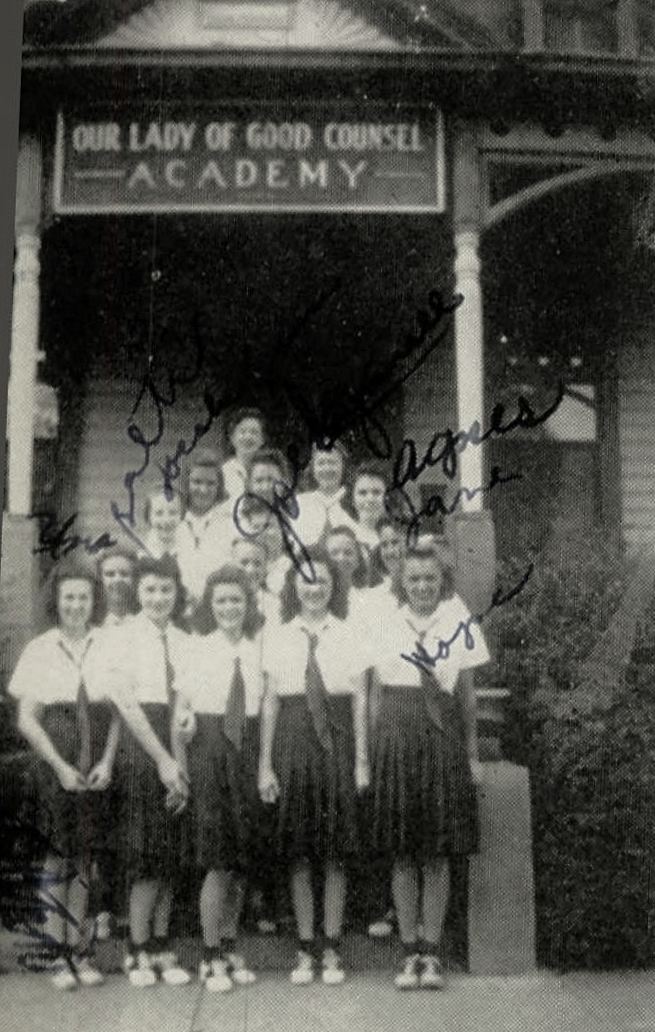
Our Lady of Good Counsel, Oak Cliff — 1901-1961

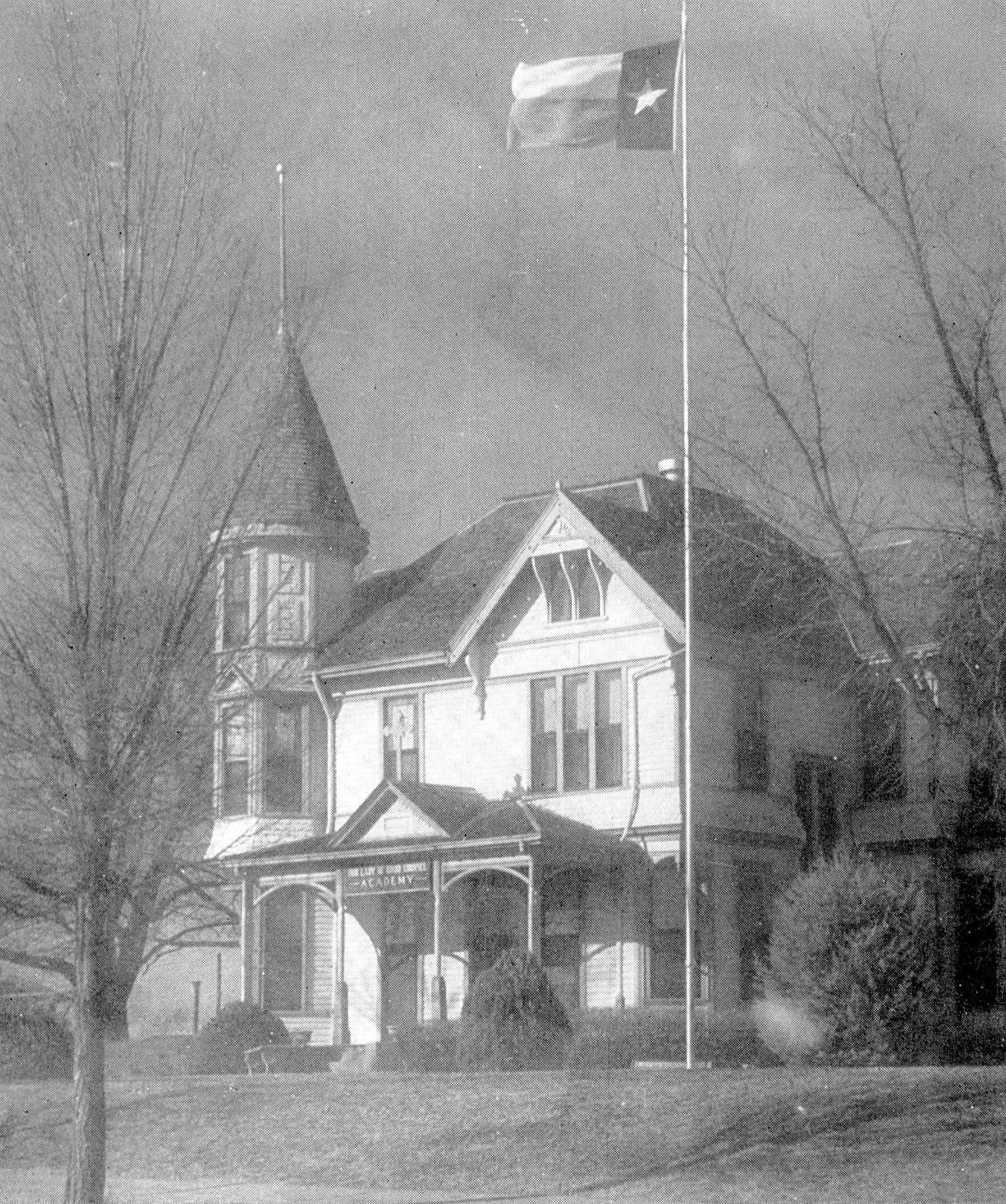
our-lady-of-good-counsel_1944-yrbkOur Lady of Good Counsel, 1944… (click for larger image)

by Paula Bosse

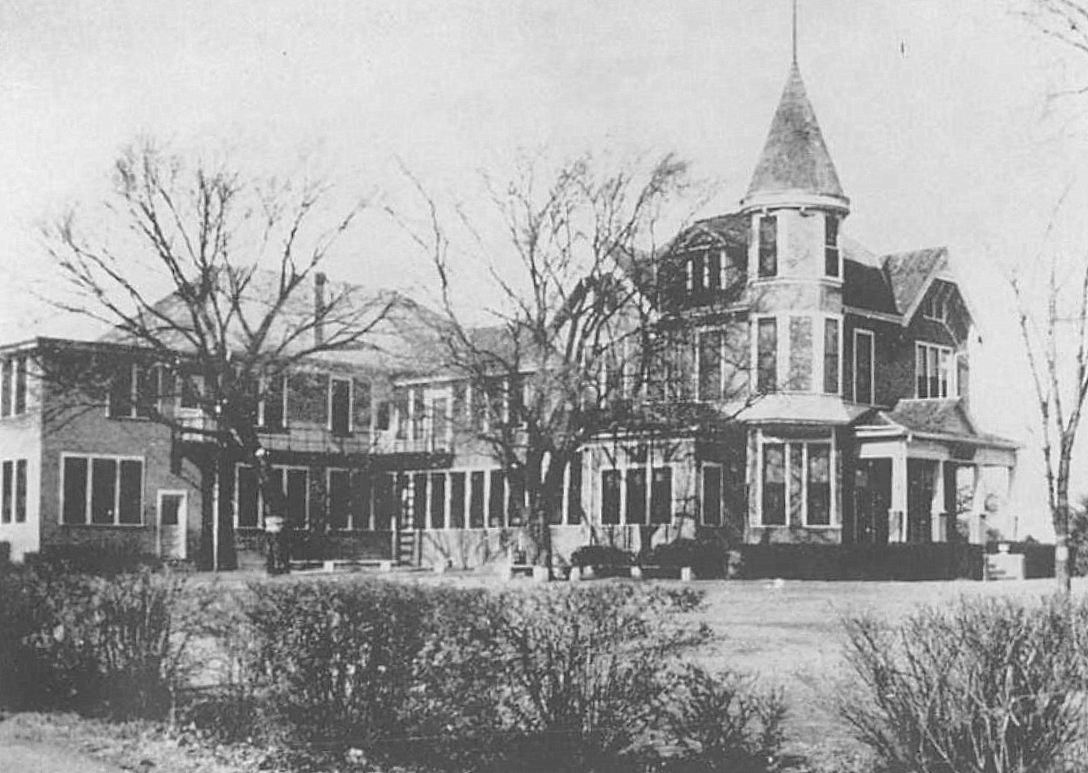
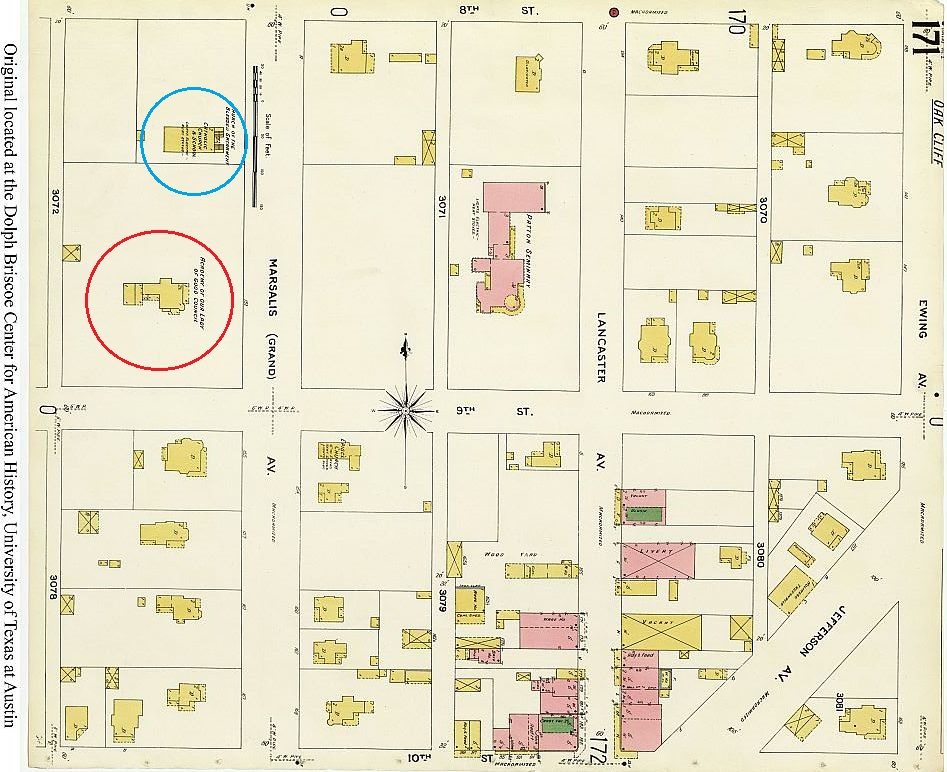
Talking to my aunt today reminded me that she briefly attended Our Lady of Good Counsel, the all-girls Catholic high school in Oak Cliff next to the Church of the Blessed Sacrament, at the northwest corner of North Marsalis (originally named Grand Avenue) and 9th Street. I’m still not sure why she went there (our family isn’t Catholic), but she seems to have enjoyed her time there for a year or two before she transferred to Crozier Tech.

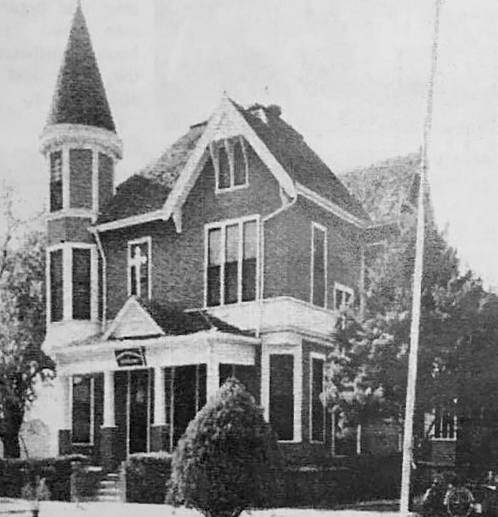
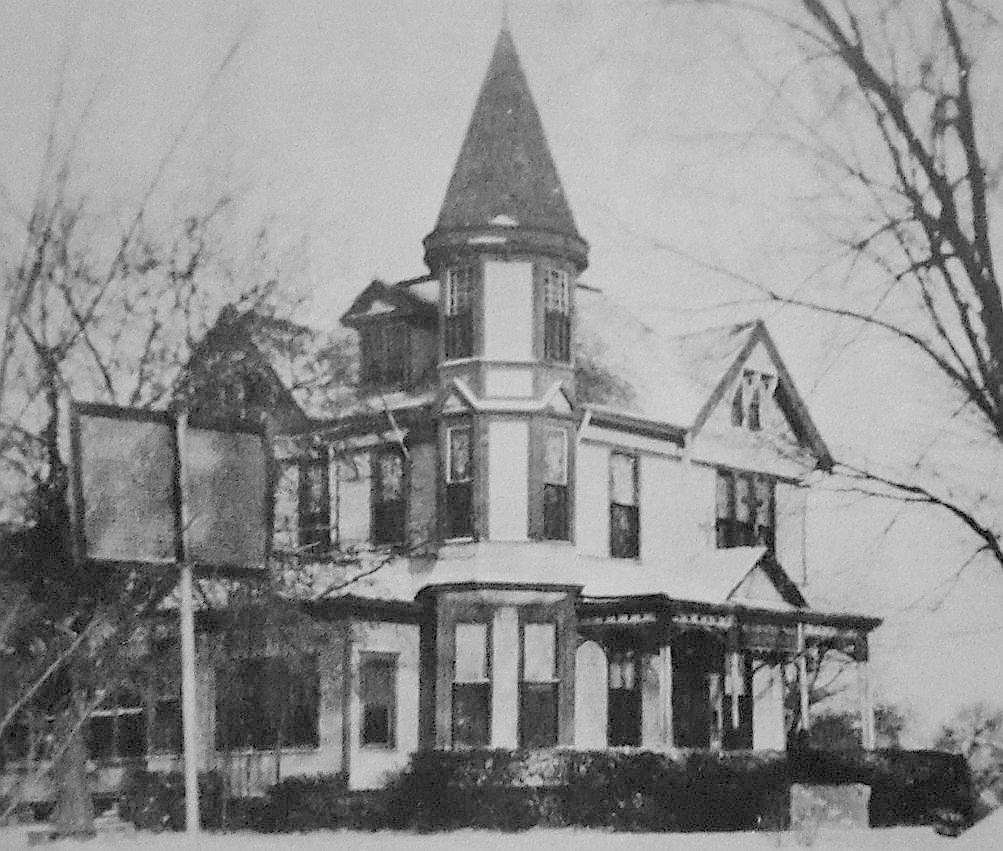
The school building was the former palatial home of wealthy businessman James T. Dargan, a one-time partner of Thomas L. Marsalis. The house was built about 1888, and according to Dallas Rediscovered author William L. McDonald, it was designed by the Dallas architectural firm of Stewart and Fuller.

dargan_1889-directory1889 Dallas directory

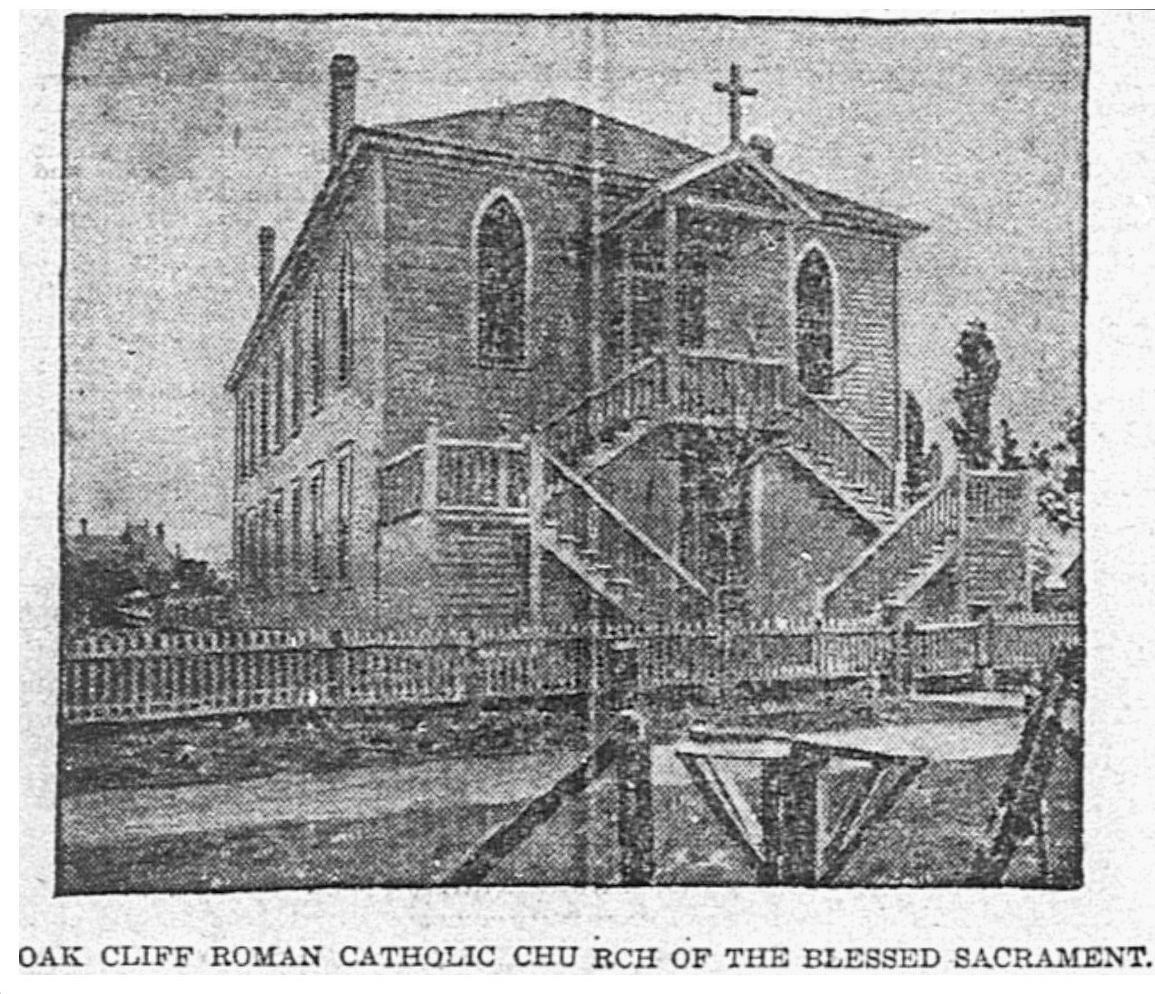
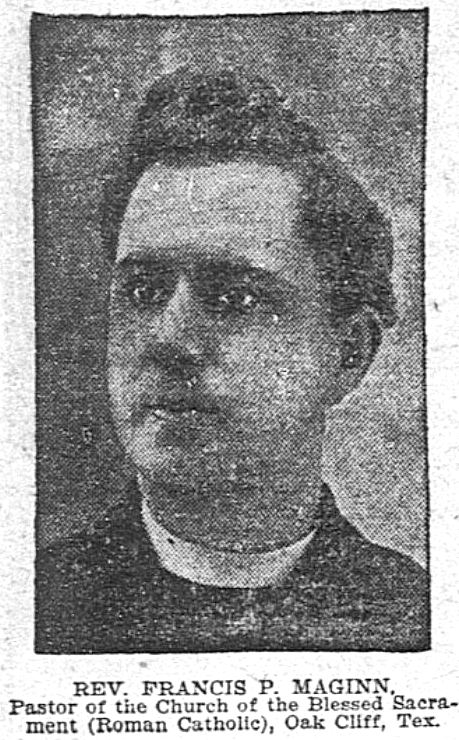
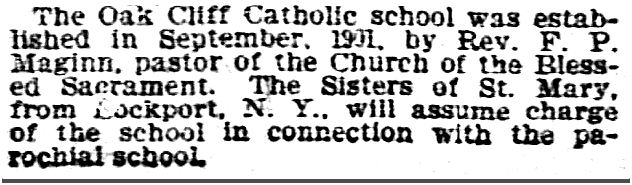
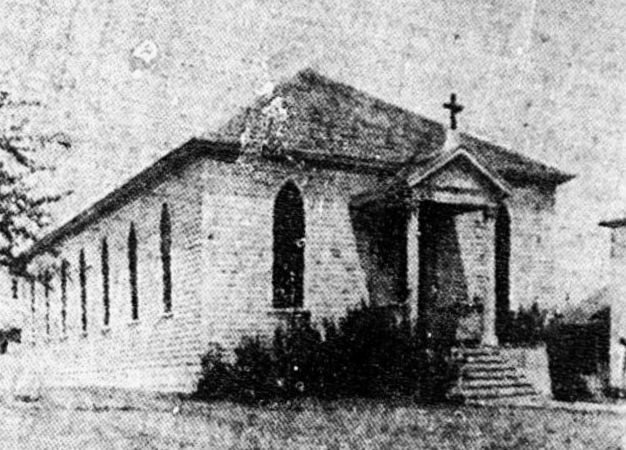
The church was holding services in Oak Cliff as early as 1901, and an affiliated school was established by Rev. Francis P. Maginn in September of that year. It appears that the Dargan house was acquired in 1902, the same year that the (new?) church building was dedicated in ceremonies officiated by Bishop E. J. Dunne.

Below, the new church can be seen in a photo which appeared in The Dallas Morning News on the day of its dedication in June, 1902 (all images are larger when clicked):

church-of-blessed-sacrament_dmn_061502_photoDMN, June 15, 1902

The neighboring school can be seen in these two early photos:

OLGC_ad_dallas-history-guild
Our Lady of Good Counsel, ca. 1902

our-lady-of-good-counsel_ca-1905_dallas-rediscovered
Our Lady of Good Counsel, ca. 1905

The school’s founder, Rev. F. P. Maginn:

maginn-francis-p_dmn_061502_church-of-blessed-sacrament
DMN, June 15, 1902

OLGC_dmn_042302DMN, April 23, 1902

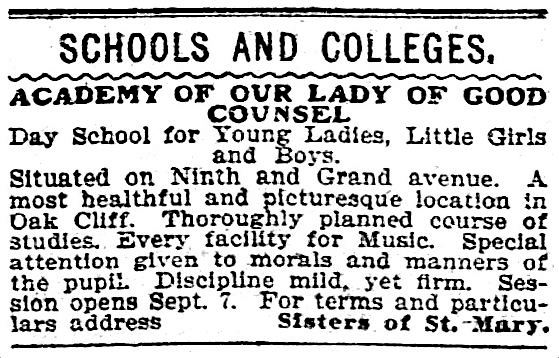
And an early ad for the school, from 1903 (“Discipline mild, yet firm”):

our-lady-of-good-counsel_1903-ad
1903

Here it is in 1942:

our-lady-of-good-counsel_1942-yrbk

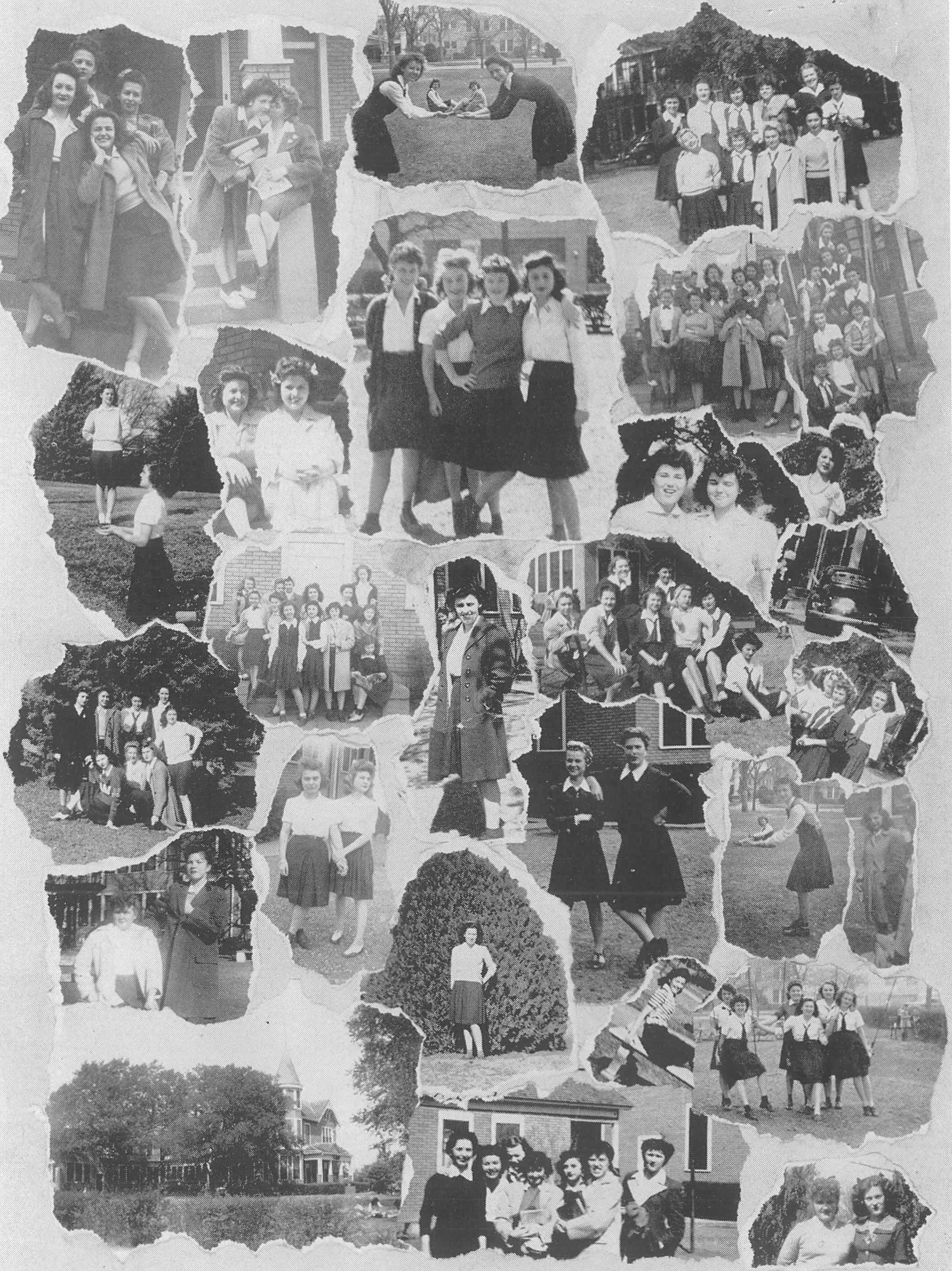
And here are some of the LGC high school students from 1944, looking bobby-soxer-y (with another view of the augmented house in the lower left corner):

our-lady-of-good-counsel_1944-yrbk_candids

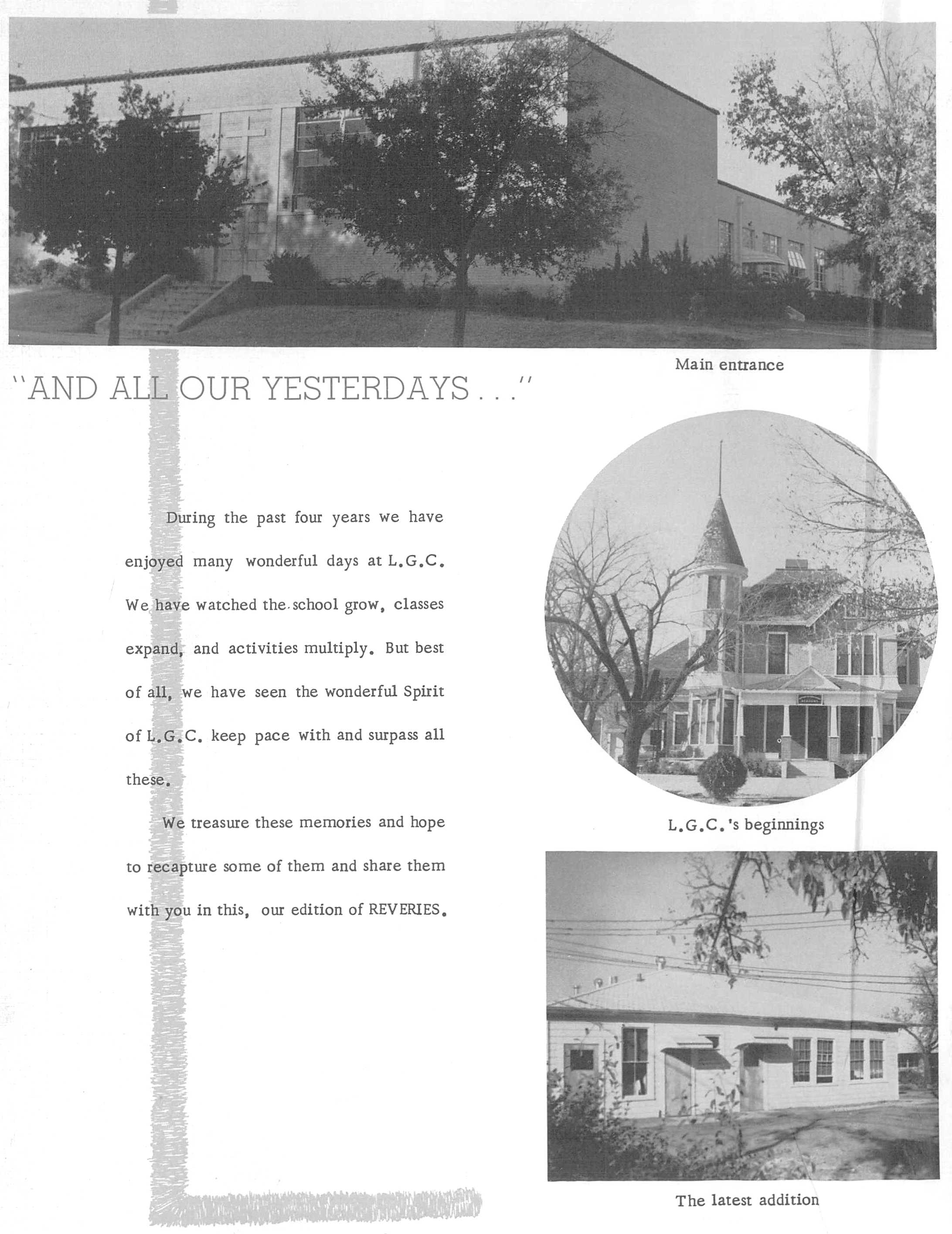
The newest additions to the building can be seen in the 1959 yearbook:

our-lady-of-good-counsel_1959-yrbk

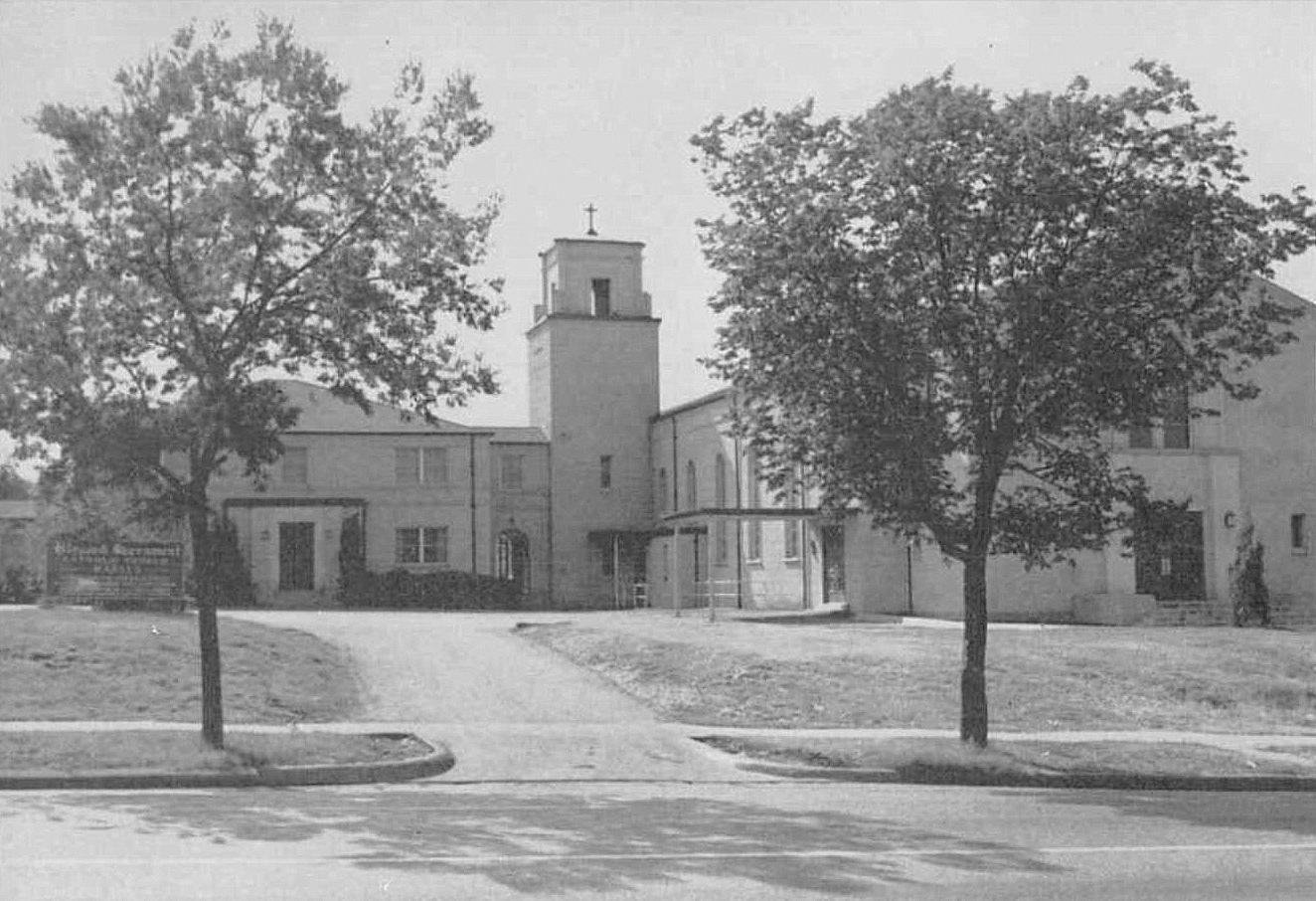
In 1961, Our Lady of Good Counsel was a fast-fading memory: a new 32-acre campus had been acquired and on it had been built the new (coed) Bishop Dunne High School. Mr. Dargan’s old house-turned-school-building was torn down a few years later, and the land became a parking lot for the Blessed Sacrament church next door (which had also seen many changes and a new building over the years). Today, the view of the land the Dargan house sat on 130 years ago looks like this. (The church looks like this.)

The church in 1930:

church-of-blessed-sacrament_1930

And in 1958 (from the LGC yearbook):

blessed-sacrament-church_OLGC-yrbk_1958

This visual aid will help give an idea of the acreage of both the school (circled in red) and the church (circled in blue), via the 1905 Sanborn map:

OLGC_sanborn_dallas-1905_sheet-171

I’m still not sure why my aunt went there….

OLGC_address_1958
1958

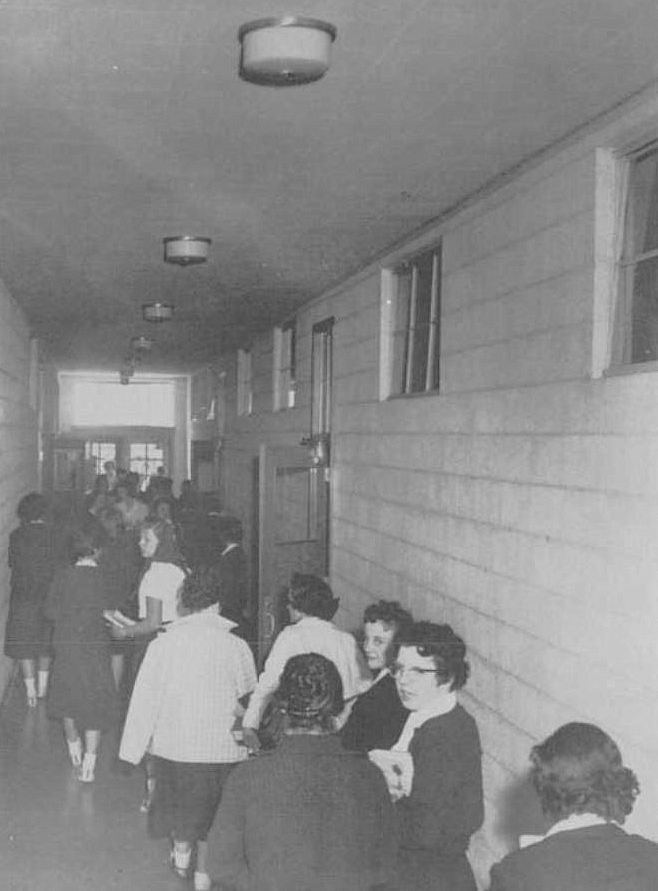
UPDATE: For those who might have wanted to see some interior photos, I didn’t find many, other than typical classroom shots, but here are some additional photos, a couple of which show the hallway.

Between classes, 1959:

OLGC_1959-yrbk_hallway

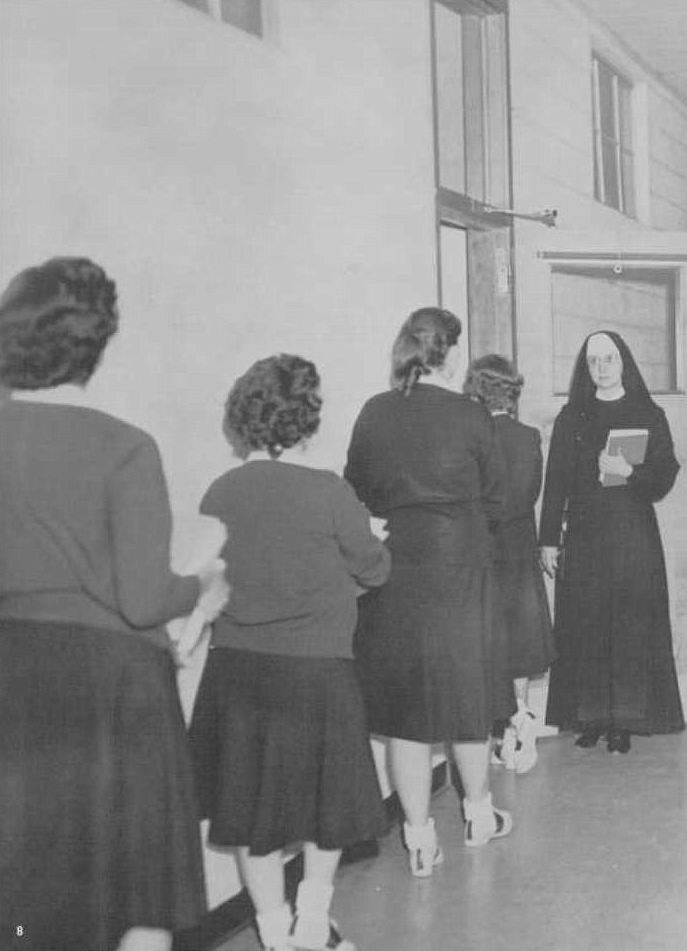
Girls lining up to go into class, 1960:

OLGC_1960-yrbk_hallway

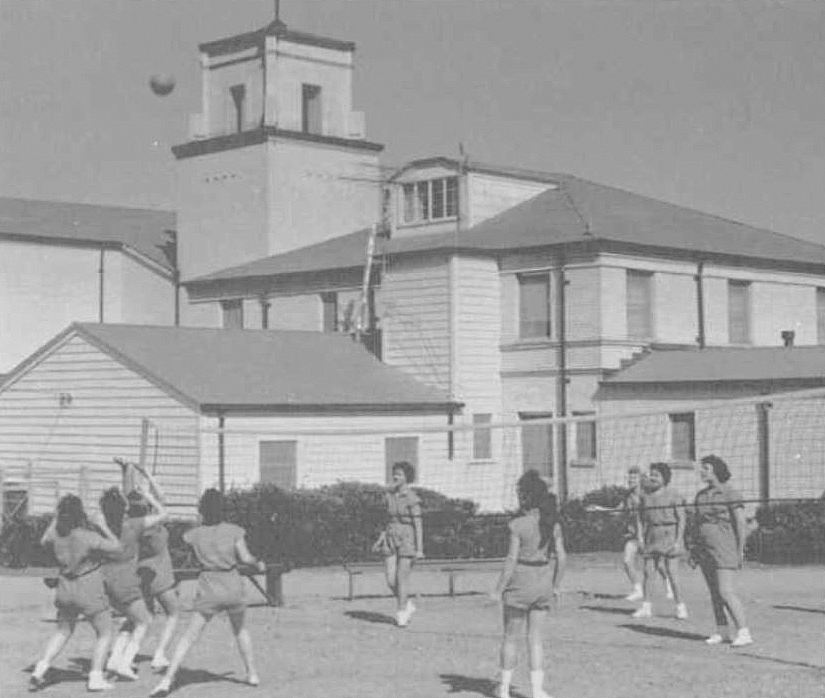
Girls outside playing volleyball, 1960:

OLGC_1960-yrbk_volleyball

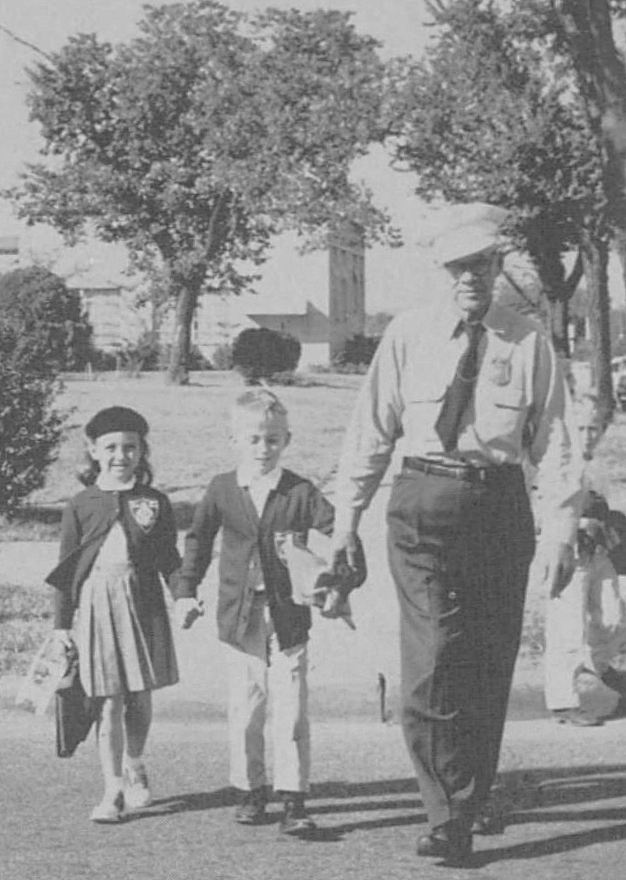
I had erroneously assumed that LGC was an all-girls 4-year high school; I believe it was a 12-year school, with boys and girls up to high school level, when it became girls-only. This photo appeared in the 1960 yearbook with the following caption: “The safety of all LGC students is the responsibility of the school as long as the students are on campus. For this reason, Officer H. A. Baxtley is available every day as a gracious escort for our little ‘Lions’ across the busy Ninth and Marsalis intersection.”

OLGC_1960-yrbk_crossing-guard

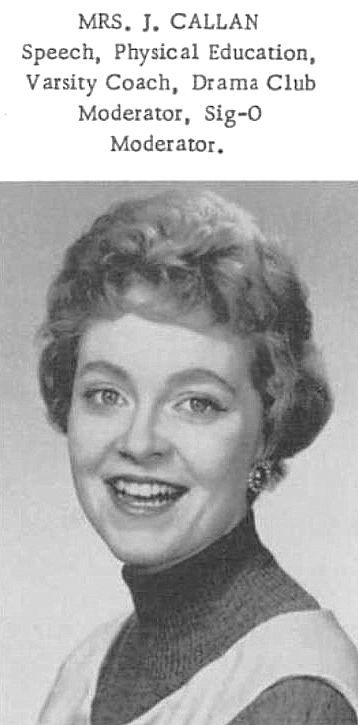
And finally, because I’m such a movie nerd who loves character actors, I was happily surprised to see that the actress K Callan was a 23-year-old drama teacher (etc.) at the school in 1959 before she entered the professional acting world of New York and Hollywood. (Callan was born in Dallas as Katherine “Kay” Borman and actually attended Our Lady of Good Counsel as a student before she taught there.) (UPDATE: Read K’s memories of her time at LGC in the comments, here.)

callan-k_our-lady-of-good-counsel_1959-yrbk_drama-teacher

callan-k_our-lady-of-good-counsel_1959-yrbk_drama-teacher_b

***

Sources & Notes

All photos of the school (except the one from 1905) are from various editions of Reveries, the yearbook for Our Lady of Good Counsel.

The 1902 photo was posted in the Dallas History Guild Facebook group.

The 1905 photo is from Dallas Rediscovered by William L. McDonald (p. 215), with the following credit: “Courtesy of Sister M. Adelaide Mars.”

The Blessed Sacrament Catholic Church still stands, at 231 N. Marsalis; their website is here.

olgc_1942-yrbk_girls_sign
1942

*

Copyright © 2017 Paula Bosse. All Rights Reserved.

Weber’s Root Beer Stands: “Good Service with a Smile”

webers-root-beer_traces-of-texasFeeling parched?  (click for larger image)

by Paula Bosse

I’ve heard of these legendary root beer stands from family members, but, sadly, I missed their heyday, which seems to stretch from the 1920s to the 1950s. The photo above was taken around 1940 in Dallas at an unknown location. (The 1940 Dallas directory lists only two stands that year: at Greenville and Richmond — currently a 7-Eleven — and at 1119 N. Zang.)

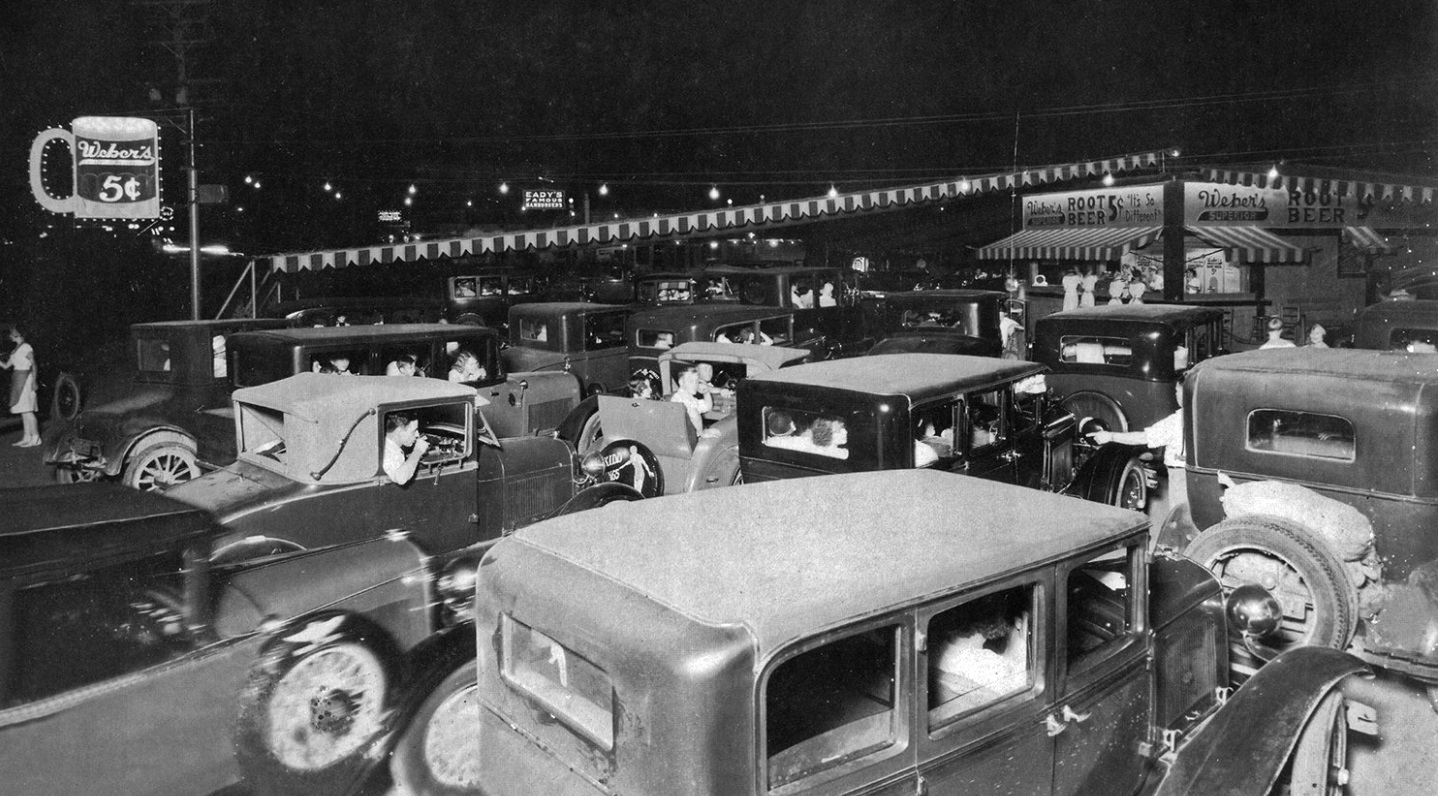
Here’s another photo, this one from 1930, taken at night, with a jam-packed lot filled with thirsty teenagers, rumble seats, and future jalopies.

webers_root-beer_traces-of-texas

In the photo above, a sign for Eady’s Famous Hamburgers can be seen in the background. This would seem to indicate that this photo was taken at one of the two locations where both Eady’s and Weber’s were neighbors: in Oak Cliff in the 1100 block of Zang, or near the Lower Greenville intersection of Greenville and Richmond. So it’s possible the two photos were taken at the same Weber’s Root Beer stand.

“It’s So Different”

ad-webers-root-beer_1930-dallas-technical-high-school-yrbk_frank-rogers

***

Sources & Notes

Top photo appeared on the fantastic Facebook page Traces of Texas. It was submitted by reader Shelly Tucker showing her aunt (second from left) working as a Weber’s carhop around 1940.

The second photo is from Traces of Texas’ Twitter feed; the source is unknown.

Ad is from the 1930 yearbook of the Dallas Technical High School (later named Crozier Tech); the photo is by the always-busy Dallas photographer, Frank Rogers.

*

Copyright © 2017 Paula Bosse. All Rights Reserved.


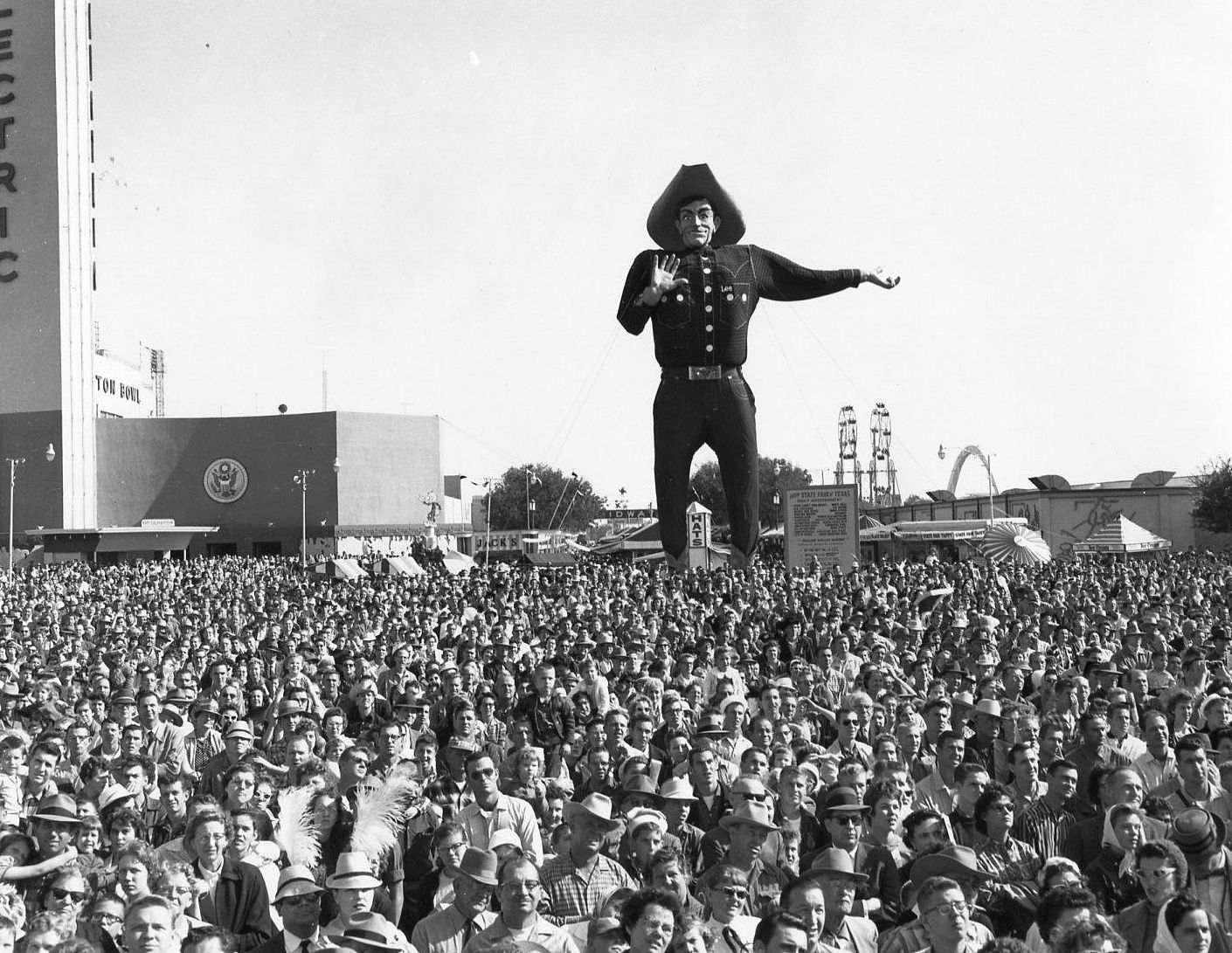
“Howdy, Folks! Welcome to the 1959 State Fair of Texas”

big-tex_1959Big Tex and his people… (click for larger image)

by Paula Bosse

Big Tex and a crowd of serious-looking adults watch something in the distance at the 1959 State Fair of Texas.

The 2017 State Fair of Texas starts in one week!

***

Sources & Notes

Source of photo: unknown!

See a whole passel of Flashback Dallas’ State Fair of Texas posts here.

*

Copyright © 2017 Paula Bosse. All Rights Reserved.

La Reunion Tower

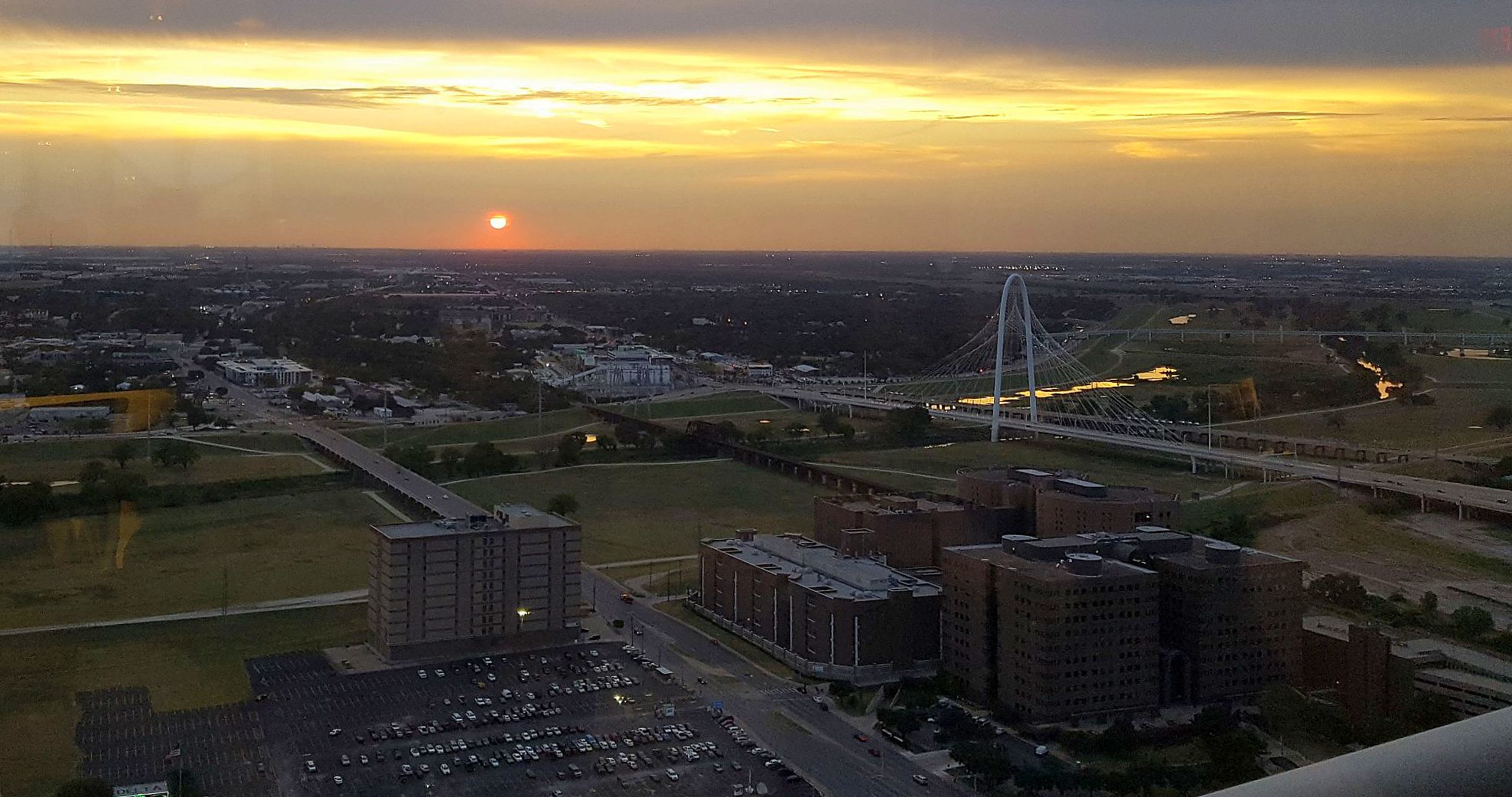
reunion-tower_skyline_091217Big D from inside the ball…

by Paula Bosse

On Tuesday night I gave a little talk on the history of the La Reunion colony as part of the Dallas Historical Society’s Pour Yourself Into History series. The event was held in the *very nice* Five Sixty by Wolfgang Puck restaurant high atop Reunion Tower — right in the ball. I was a bit of a last-minute fill-in presenter, and I hesitated to accept the invitation because I always feel awkward talking in front of more than, say, two or three people, but I really, really wanted to go up to the top of Reunion Tower.

I hadn’t been to Reunion Tower since a family outing back in the ’80s. Back then I was most fascinated by the fact that the restaurant slowly revolved to give diners a leisurely 360-degree view of the city (I always imagined it spinning out-of-control, pinning diners — and their meals — against the walls with centrifugal force, like a fine-dining version of the Spindletop ride at Six Flags, or The Rotor ride at the State Fair of Texas); but now, decades later, as an adult, the image of the spinning restaurant was eclipsed by the real star: the VIEW.

As you can imagine, the view is unbelievably spectacular — especially at night when Dallas is at its most glamorous. The ticket price is fairly steep to get up to the observation deck, and a meal and/or cocktails at the restaurant will set you back a goodly amount, but it is, without question, the most fabulous view of the city you’ll ever see. And you see all of it. When I started my talk about the history of the La Reunion colony of the 1850s (which was located about 5 miles due west of Reunion Tower, in West Dallas) the view was pretty much the one seen in the photo above; by the time I finished, we were, serendipitously, looking out over where the plucky colonists of “French Town” had toiled unsuccessfully 160 years ago. (Estimates on the boundary of La Reunion’s 2,000-acre land is the area now bounded by Westmoreland on the west, Hampton on the east, Davis on the south, and the Trinity River on the north — the southwest corner is marked here on Google Maps.)

It was a little noisy at the event Tuesday night, so if you were one of the very nice people who turned out, you might not have been able to hear anything I said! If you’d like to hear more about the history of La Reunion (and about Reunion Tower — and how, if a marketing agency had had its way, it might have been named “Esplanade” Tower), I enthusiastically recommend this very entertaining radio piece from Julia Barton (the La Reunion segment begins at about the 5:15 mark).

**

I took photos, but they don’t do justice to the view. The really breathtaking vistas are at night, and, sadly, none of those photos came out. Seriously, if you’ve never been up Reunion Tower — or if you haven’t been since it was opened in 1978 — you should definitely go now. Better still, go at sunset and enjoy the best view in Dallas as you sip delicious cocktails.

The view stretches for miles. Here’s a cropped view of Dealey Plaza (click to see it really big).

reunion-tower_dealey-plaza_triple-underpass_091217a

And, at sunset, the jail has never looked lovelier.

reunion-tower_sunset_jail_091217

Back down on terra firma, looking up and saying “goodbye” to the ball.

reunion-tower_the-ball_091217

Thank you, Dallas Historical Society, for inviting me to be part of your event! And thanks to everyone who came out … and up!

***

Sources & Notes*

Photos by Paula Bosse. Click ’em to see ’em bigger.

For more information of the La Reunion colony, see other Flashback Dallas posts here.

*

Copyright © 2017 Paula Bosse. All Rights Reserved.

The Gill Well

gill-well_highland-park_dallas-rediscoveredThe Highland Park pagoda… (click for larger image)

by Paula Bosse

I never heard of the Gill Well growing up — in fact, it wasn’t until around the time I started this blog — about three or four years ago — that I first became aware of it. Though largely forgotten today, the Gill Well used to be a pretty big deal in Dallas: for years, early-20th-century entrepreneurs tried valiantly and persistently to capitalize on the mineral-heavy artesian water from this well — the plan was to use this hot spring water in order to turn Dallas (or at least Oak Lawn) into, well, “the Hot Springs of Texas.” We came so close!

So — Gill Well? Who, what, when, where, why, and how?

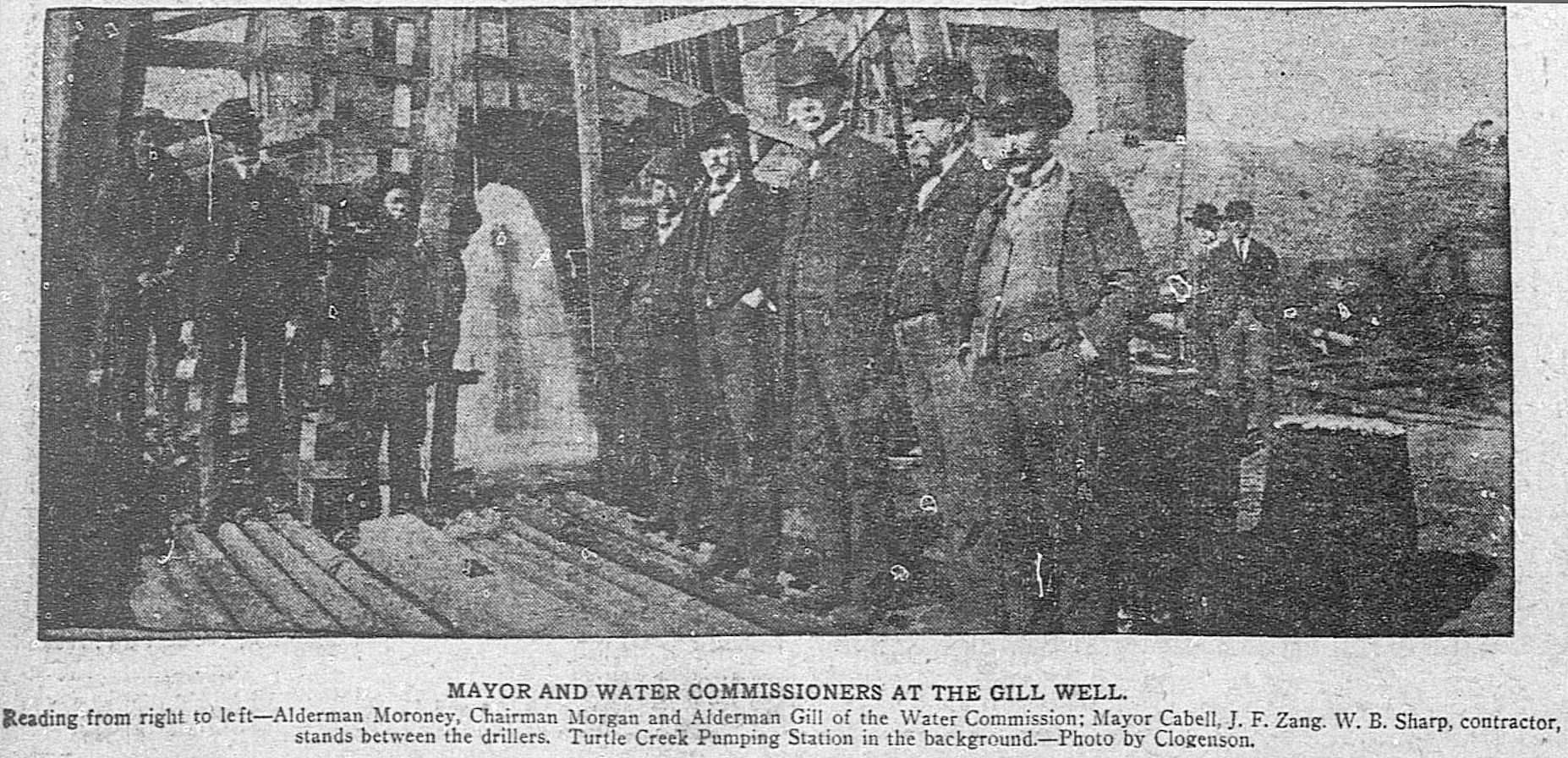
In 1902 city alderman and water commissioner C. A. Gill proposed sinking an artesian well near the Turtle Creek pumping station in order to determine if the flow of water in underground springs was sufficient to augment Dallas’ water supply (there was, at the time, another such test well being drilled in West Dallas). The City Council was on board and wanted this test well to be a deep well, “the deepest in the state — in order to settle once and for all the question as to whether or not there lies beneath the earth in this section a body of water, or ‘an underground sea,’ as some call it, of sufficient size to supply the needs of all the people” (Dallas Morning News, Aug. 6, 1902).

Fellow alderman Charles Morgan explained Gill’s proposition to the people of Dallas in a prepared statement to the Morning News:

By sinking artesian wells it is not intended to abandon the plans proposed to secure an adequate storage supply from surface drainage, but that the artesian wells shall augment the supply. We can not get too much water, but if we secure an ample artesian supply our storage basins will be reserve. There will be no conflict. We simply make success double sure. (Alderman Charles Morgan, DMN, Aug. 24, 1902)

The well was sunk in September or October of 1902 near the Turtle Creek pumphouse (which was adjacent to where a later station was built in 1913, the station which has been renovated and is now known as the Sammons Center for the Arts — more on the construction of that 1913 station and a photo of the older pumphouse can be found here); the drilling was slow-going and went on until at least 1904, reaching a depth of more than 2,500 feet. It’s a bit out of my area of expertise, but, basically, good, palatable artesian water from the Paluxy sands — water “free from mineral taint” — was found, but, deeper, a larger reservoir of highly mineralized “Gill water” — from the Glen Rose stratum — was found. That was good news and bad news.
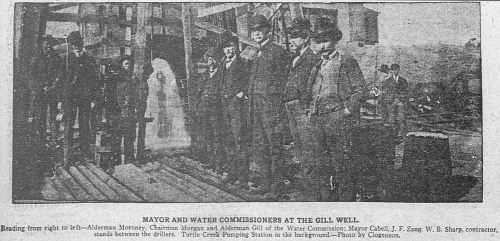
gill-well_dmn_120103Dallas Morning News, Dec. 1, 1903

The “bad news” came from the fact that a part of a pipe casing became lodged in the well, causing an obstruction in the flow of the “good” water from the Paluxy formation. Again, it’s a bit confusing, but the heavy flow of 99-degree-fahrenheit mineral water (which was corrosive to pipes) threatened to contaminate the “good” Paluxy water … as well as the water from the Woodbine formation from which most (all?) of the private wells in Dallas secured their water. (Read detailed geological reports on the well in a PDF containing contemporaneous newspaper reports here — particular notice should be paid to the comprehensive overview of the well and its problems which was prepared for the Dallas Water Commission by Engineer Jay E. Bacon and published in the city’s newspapers on May 10, 1905).

So what the City of Dallas ended up with as a result of this Gill Well was a highly dependable source of hot mineral water. But what to do with it? Monetize it!

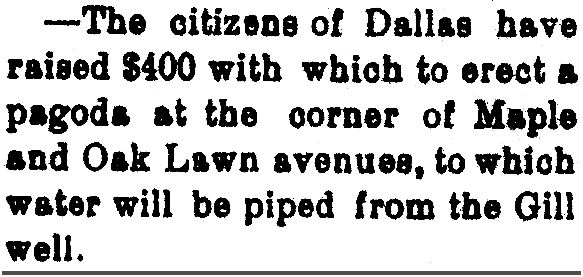
As part of the city’s water supply, the mineral water was made available to Dallas citizens free of charge: just show up at one of the handful of pagoda-covered dispensing stations with a jar, a bucket, or a flask, and fill up with as much of the rather unpleasant-smelling (and apparently quite powerful!) purgative as you could cart home with you. (For those who didn’t want to mingle with the hoi polloi, home delivery was available for a small fee.) One such “pagoda” was erected a short distance away, in front of the city hospital (Old Parkland) at Maple and Oak Lawn (the healthful water was also piped directly into the hospital for patient use).
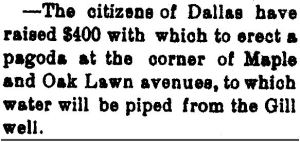
gill-well-parkland-pagoda_brenham-weekly-banner_040605
Brenham Weekly Banner, April 6, 1905

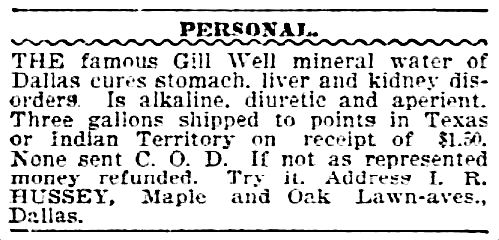
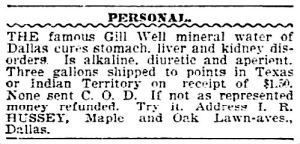
One man, however, began offering the water for sale beyond Dallas, hoping to cash in on the free-flowing tonic (see the mineral-content breakdown here), but the city clamped down on him pretty quickly as he was not an authorized agent. From his 1906 ad, one can see that the reputation of Gill water and its healing and restorative powers was already widely known.
gill-well-water_dmn_080206
DMN, Aug. 2, 1906

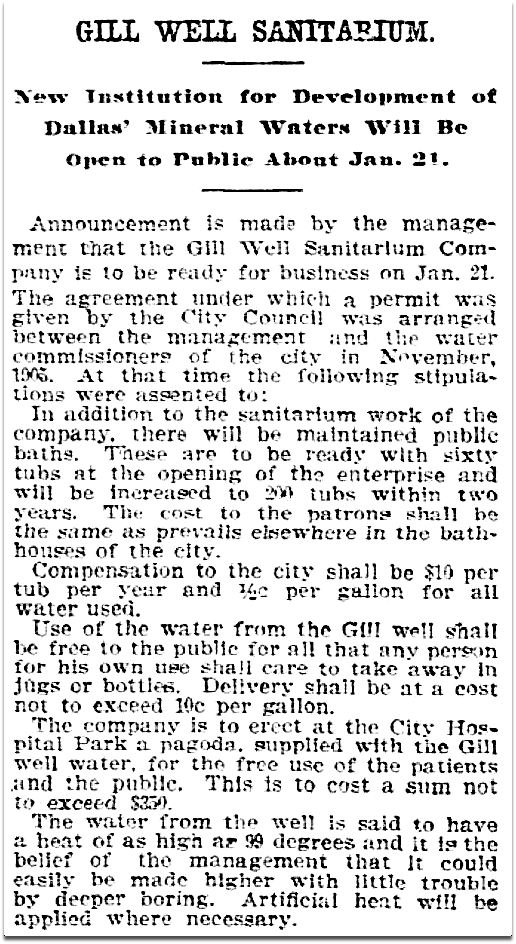
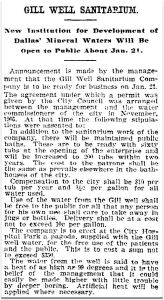
If the water was not to be sold, what was the City of Dallas going to do with it? It was decided to pipe the the water a short distance from the test well to nearby property adjacent to the land now occupied by Reverchon Park, then lease the access to the water to a capitalist who would build a sanitarium/spa where people could come to “take the waters” — to bathe in the naturally warm, mineral-heavy artesian water with mystical recuperative properties. The sanitarium would make money by charging its patrons for its services, and the city would collect a small annual income based on the number of the sanitarium’s bathing tubs and the amount of water used:

Compensation to the city shall be $10 per tub per year and one-half-cent per gallon for all water used. (DMN, Jan. 4, 1907)

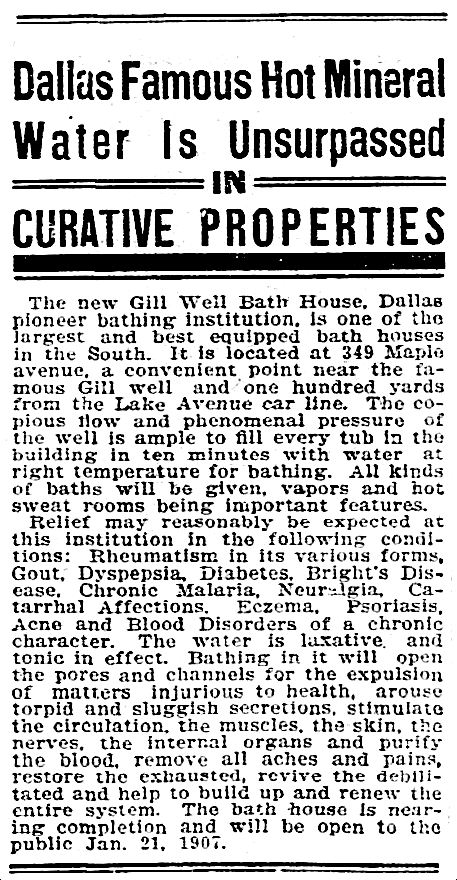
The Gill Well Sanitarium and bath house opened in January 1907, on Maple Avenue just north of the MKT Railroad (now the Katy Trail). (Most clippings and pictures in this post are larger when clicked.)
gill-well-sanitarium_dmn_010407DMN, Jan. 4, 1907

I searched and searched and searched for a picture of the building and, hallelujah, I finally found one, in the pages of The Dallas Morning News, taken by photographer Henry Clogenson. (This is the only picture I’ve been able to find of it, and, I have to say, it’s not at all what I expected the building to look like. It actually looks like something you’d see in a present-day strip mall.)
gill-well-sanitarium_dmn_011307_photoDMN, Jan. 13, 1907

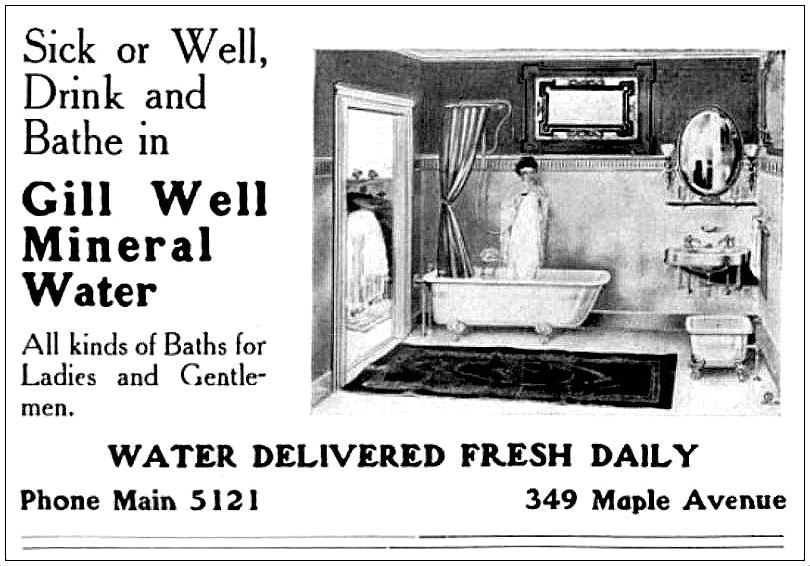
gill-well-sanitarium_dmn_010607_ad
Advertisement, DMN, Jan. 6, 1907

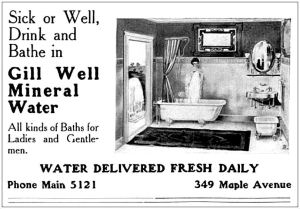
Business at the new sanitarium was very good, and the public fountains/spigots at both the sanitarium property and a block or so away at the city hospital continued to be popular with residents who needed a boost or a “cure” and stopped by regularly for a sip or a pail of the free mineral water.
gill-well_ad_dallas-police-dept-bk_1910_portal1910 ad

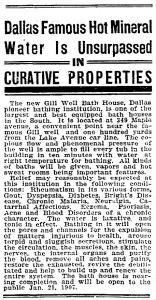
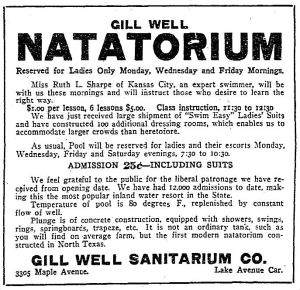
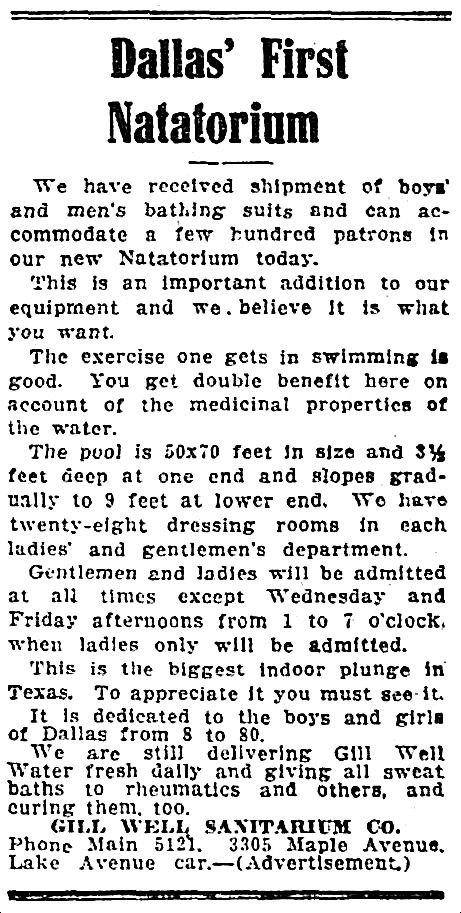
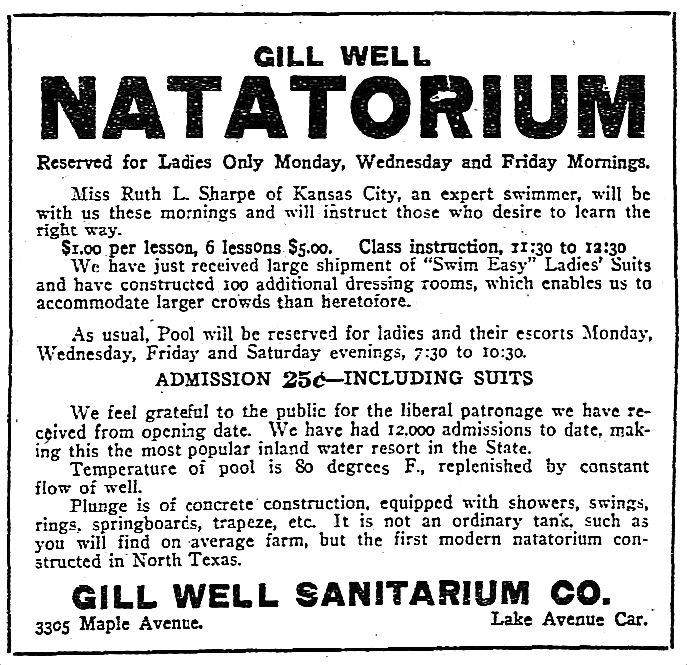
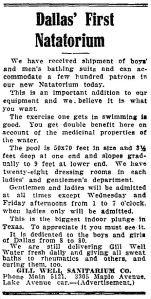
In 1912 a natatorium (an indoor swimming pool) was added and proved even more popular. It was open to men, women, and children; admittance and bathing suit rental was 25¢ (about $6.50 in today’s money). (Contrary to the headline of the ad below, it was not Dallas’ first natatorium — there was one near City Park on South Ervay by at least 1890 — but it was probably the first pool in the city filled with warm mineral water.)
gill-well_natatorium_dmn_041412
DMN, April 14, 1912

gill-well-natatorium_dmn_070712
DMN, July 7, 1912

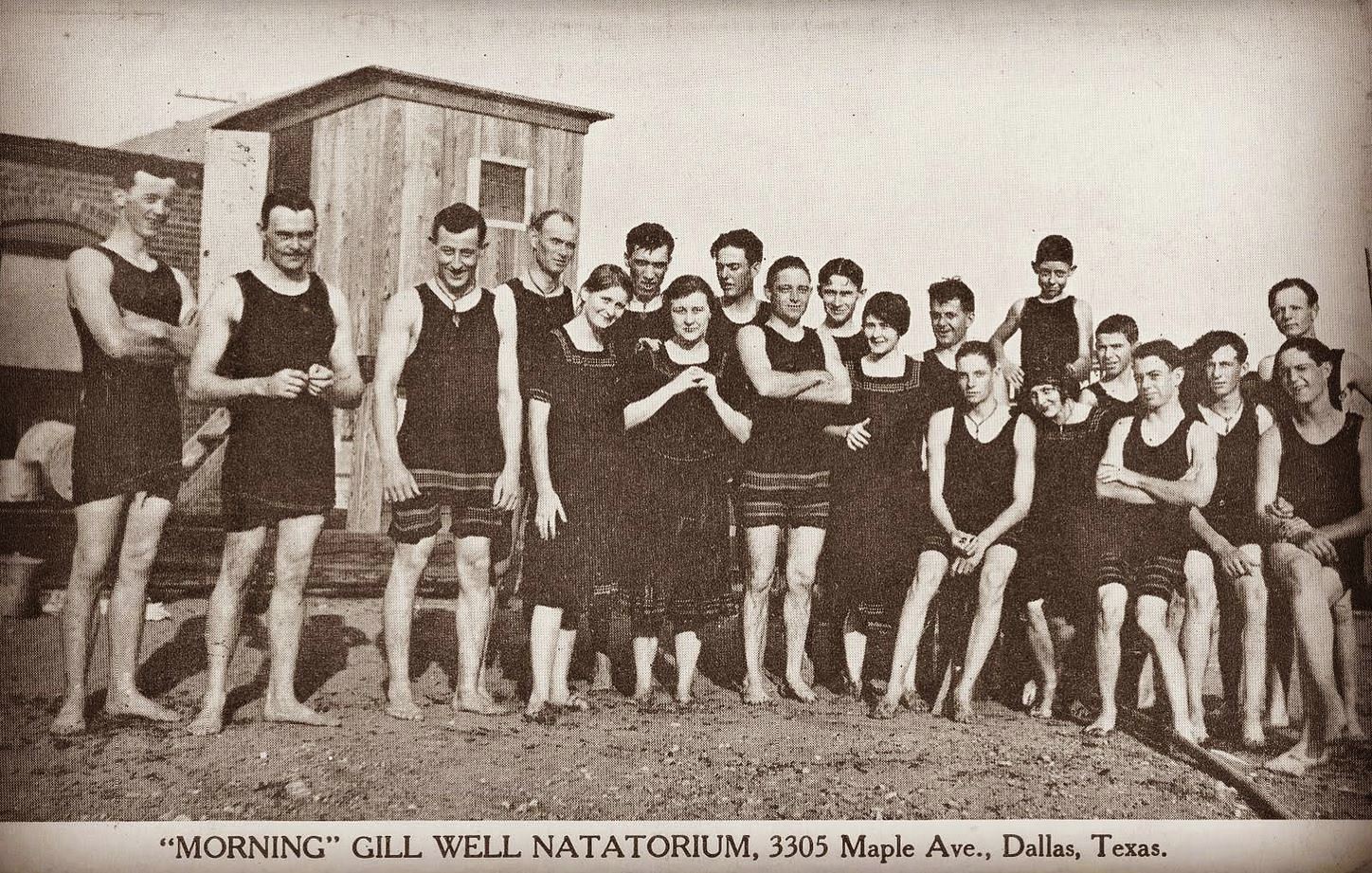
gill-well-natatorium_texas-swimming-and-diving-hall-of-fameCourtesy of the Texas Swimming and Diving Hall of Fame
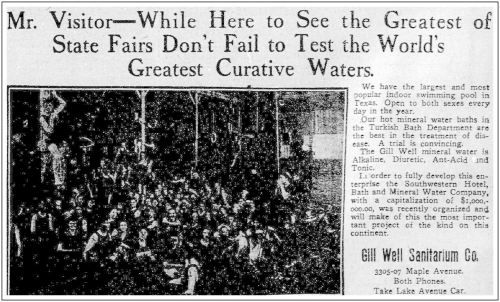
gill-well-natatorium_dmn_100612DMN, Oct. 6, 1912

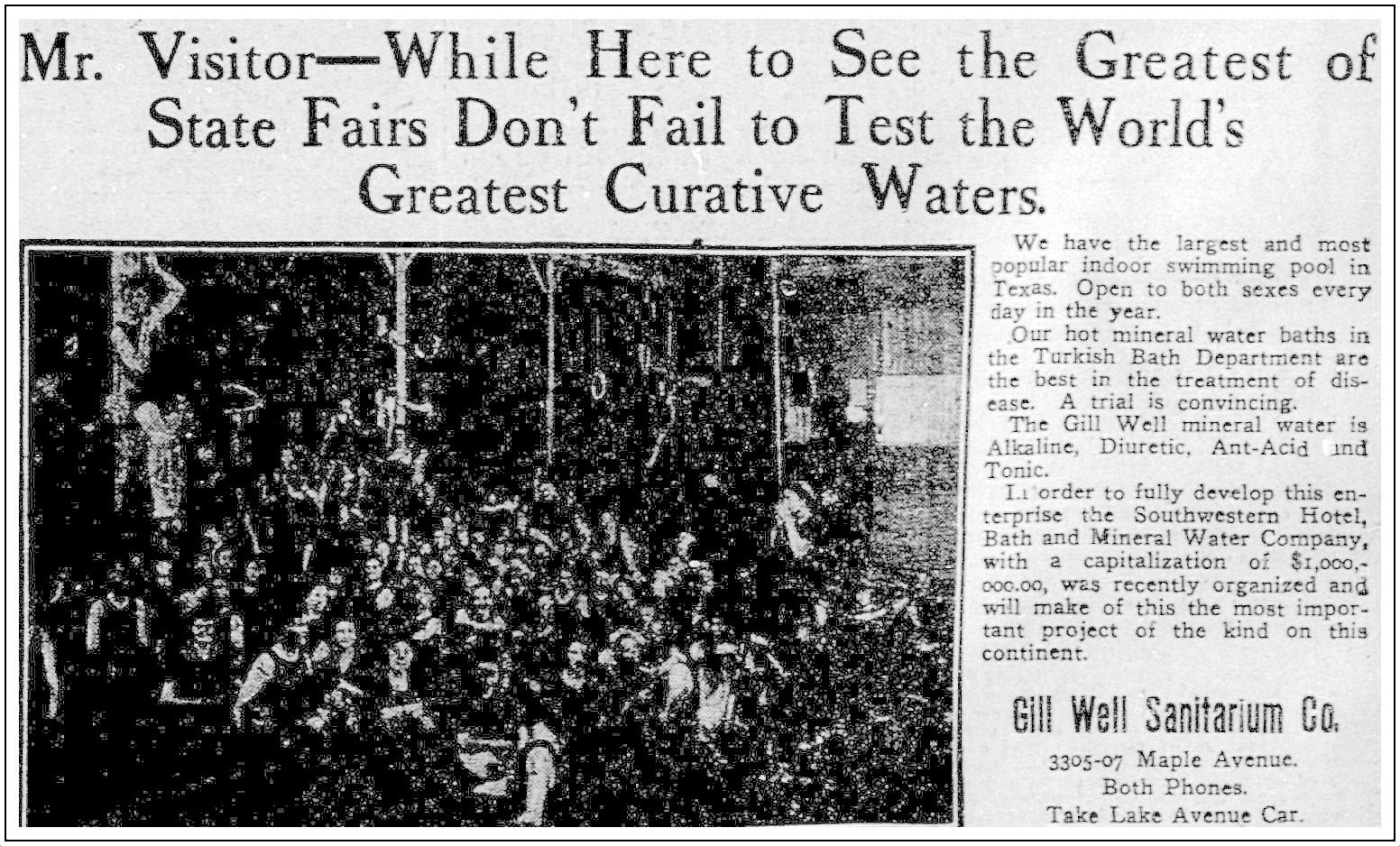
The last paragraph of the ad above mentions a plan to pipe Gill water to a hotel downtown — not only would the Gill Well Sanitarium Company’s services be offered in the heart of the city amidst lavish hotel surroundings (instead of in Oak Lawn, way on the edge of town), but the company would also be able to compete with Dallas’ other (non mineral-water) Turkish baths — then they’d really be rolling in the cash. As far as I can tell, nothing came of the plan, but the men behind it were pretty gung ho, as can be seen in this rather aggressive advertorial from the same year:

ad-sanitorium-baths_blue-bk_1912The Standard Blue Book of Texas, 1912

All seemed to be going well with the sanitarium until the city and the Missouri, Kansas & Texas Railroad (the MKT, or the Katy) decided to remove the railroad’s grade crossings through the Oak Lawn area (all work which was to be paid for by the railroad). Double tracks were to be added and crossings were either raised or the streets were lowered. The crossings affected were Lemmon, Cedar Springs and Fairmount (where street levels were cut down to go under the tracks) and Hall, Blackburn, and Bowen (where tracks would be elevated). Also affected: Maple Avenue. (Read more about the MKT plan in the Dallas Morning News article from Aug. 23, 1918 — “Dallas Is Eliminating Four Grade Crossings” — here.)

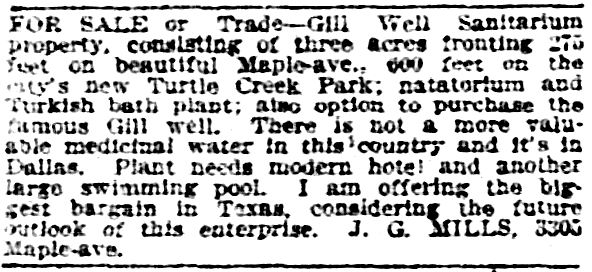
The Maple Avenue-Katy Railroad crossing had long been a dangerous area for wagons, buggies, and, later, automobiles. Not only was it at the top of a very steep hill (see what that general area north of that crossing looked like around 1900 here), but it also had two sharp curves. The decision was made to straighten Maple Avenue between the approach to the railroad crossing and Oak Lawn Avenue at the same time Maple was being lowered and the Katy track was being raised. (Read the announcement of this plan — “Straighten Maple Avenue Is Plan” — from the Nov. 29, 1917 edition of The Dallas Morning News, here.) The only problem — as far as the Gill Well Sanitarium was concerned — was that the straightened road would go directly through the sanitarium property. I don’t know if the long-time owner of the sanitarium, J. G. Mills, knew about this approaching dire situation, but in 1915 — just a few short months after boasting in advertisements that more than 50,000 patients had availed themselves of the sanitarium’s amenities in 1914 — he placed an ad seeking a buyer of the business (although, to be fair, he’d been trying to sell the company for years):
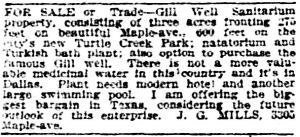
gill-well_dmn_080815_for-saleDMN, Aug. 8, 1915

(In the ad he states that the buyer had an option to purchase the actual well, but the city had never expressed any desire to sell either the well or the full rights to the water.)

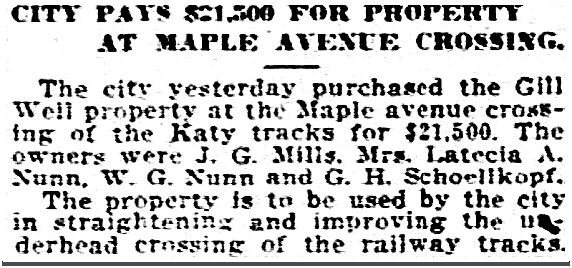
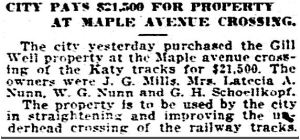
The Gill Well Sanitarium Co. appears to have been dissolved in 1916, but there was still hope that a sanitarium/hot springs resort could continue on the property. In 1917, interested parties petitioned the city to change its plans to straighten Maple, arguing that it would destroy any ability to do business on the site, but the city went forward with its plans, and in November 1919, the City of Dallas purchased the land from the group of partners for $21,500 (about $305,000 in today’s money).
gill-well_dmn_111319
DMN, Nov. 13, 1919

The monetization of water from Dallas’ fabled Gill Well ended after ten years.

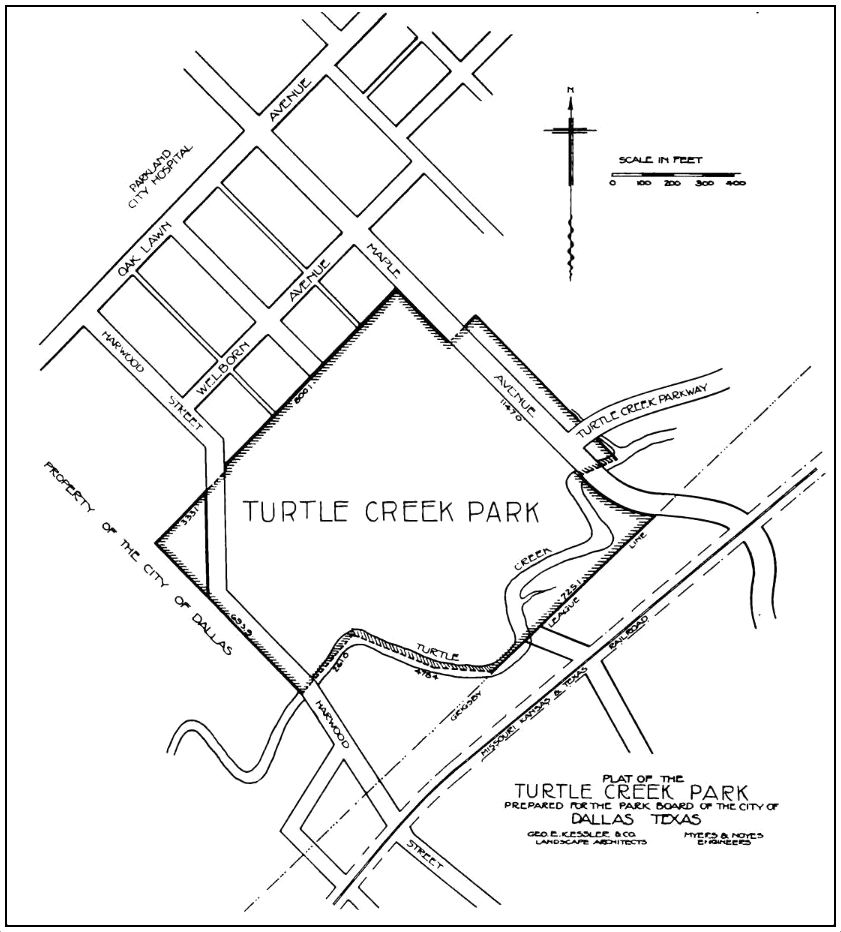
I had never heard of Maple Avenue being straightened. Below is a map of Turtle Creek Park (which became Reverchon Park in 1915), showing Maple’s route, pre-straightening — the main buildings of the sanitarium were in the bulge just west of Maple, between the Katy tracks and the boundary of the park.

reverchon-park_turtle-creek-park_map_1914-15
1915 map, via Portal to Texas History

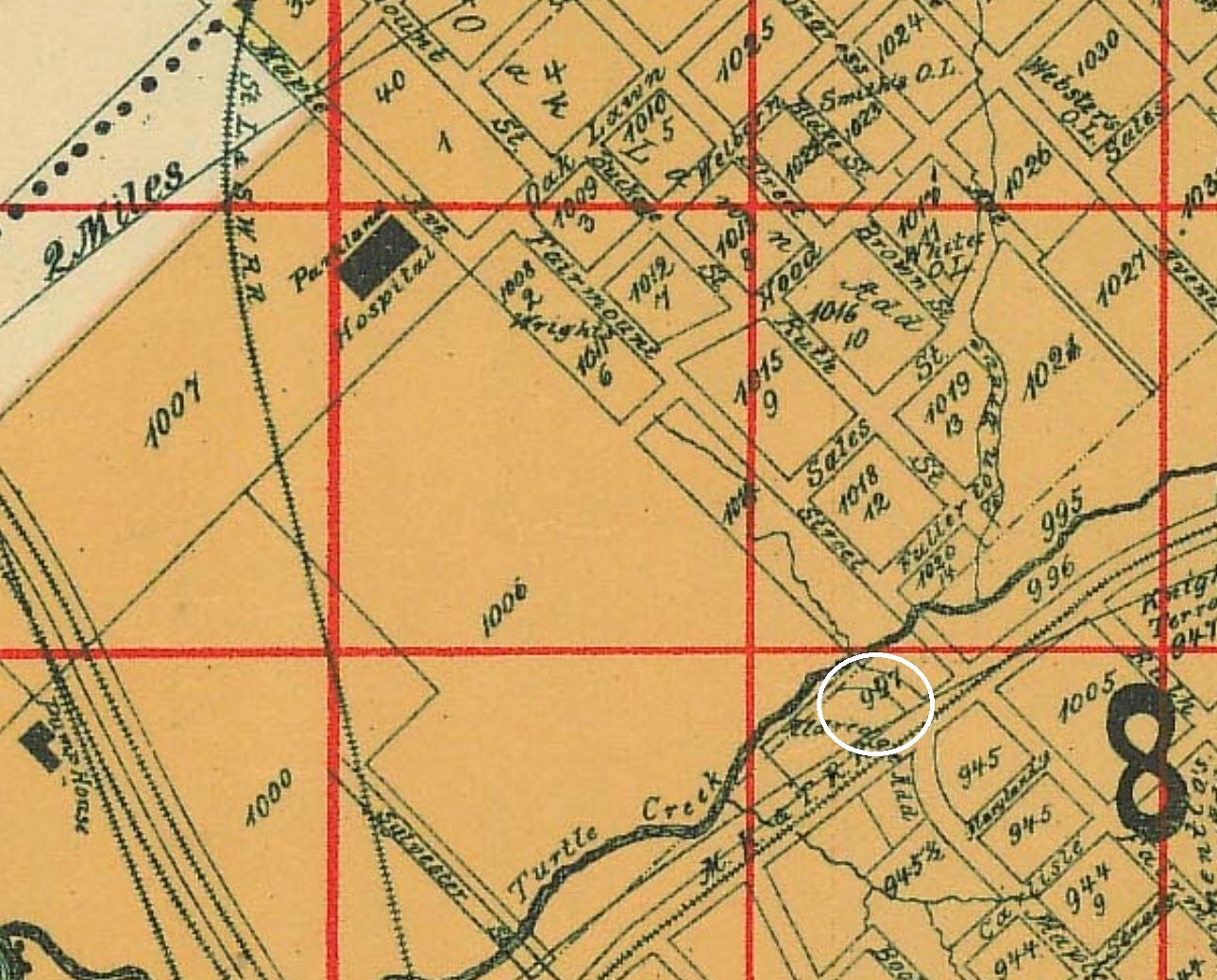
Another view can be seen in a detail from a (fantastic) 1905 map, with the approximate location of the Gill Well Sanitarium circled in white:
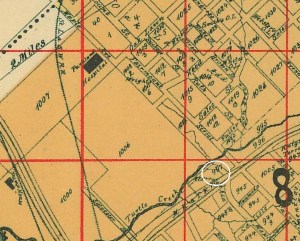
maple-ave_1905-map_portal_det_gill-wellWorley’s Map of Greater Dallas, 1905

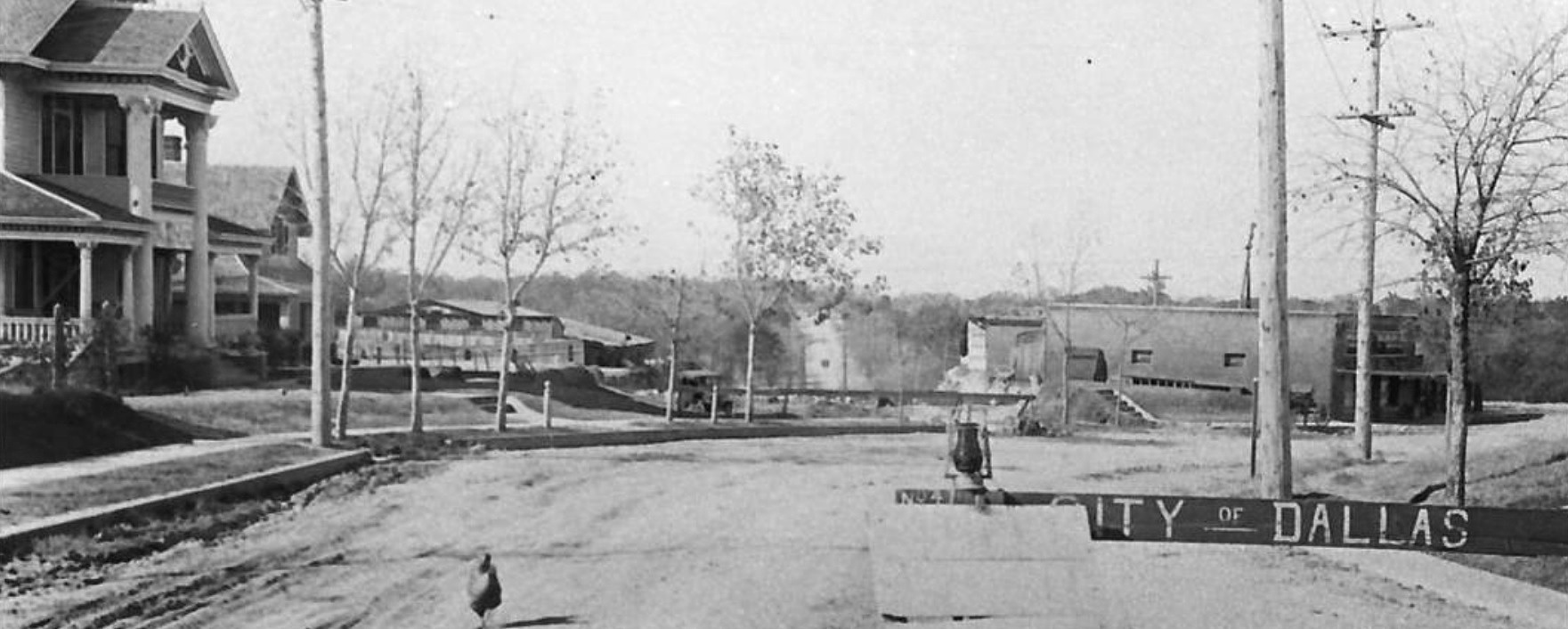
A year or more ago I saw the photo below on the Big D History Facebook page but had no idea at the time what I was looking at: it apparently shows Maple Avenue in 1918, taken from about Wolf Street (probably more like Kittrell Street), which was then near the city limits, looking north. You can see the curve Maple makes and the steep hill — that large building at the right must be the sanitarium and/or the later-built natatorium.

maple-ave_road-construction_from-wolf_1918_big-d-history-FB

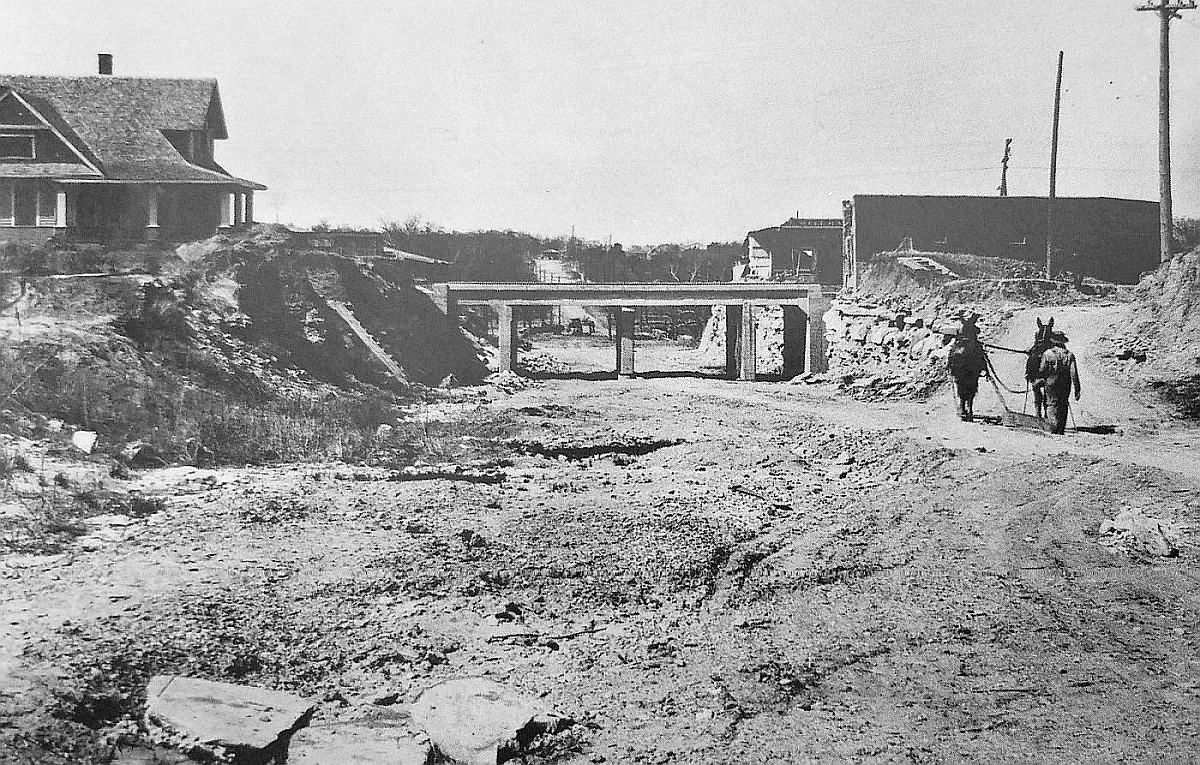
The photo below shows the road-straightening in progress, with the MKT bridge now spanning Maple Avenue.

maple-MKT_ca-1920_DPLDallas Public Library

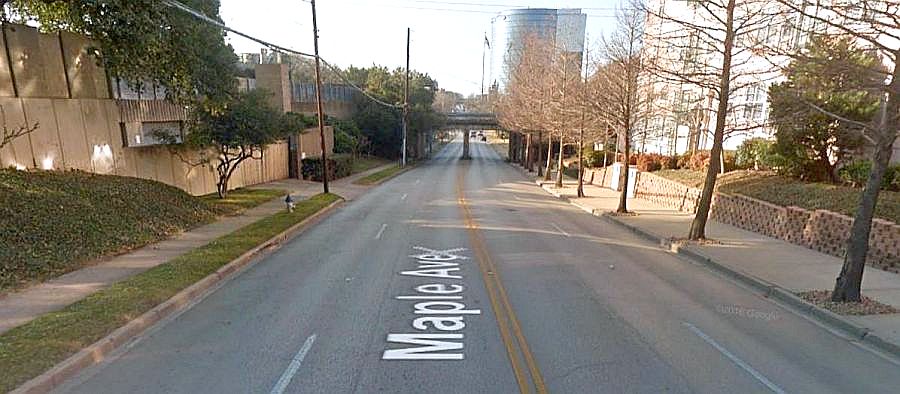
And here it is almost a hundred years later:
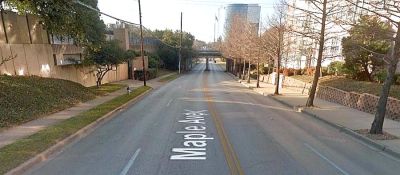
maple-MKT_google-street-view_2014Google Street View, 2014

So the Gill Well Sanitarium and Bath House was closed, the land was purchased by the City of Dallas, Maple Avenue was straightened, and, in the summer of 1923, the remaining abandoned buildings on the property were demolished. But that didn’t spell the end of the famous Gill Well water.

Highland Park’s “Gill Water” Pagoda

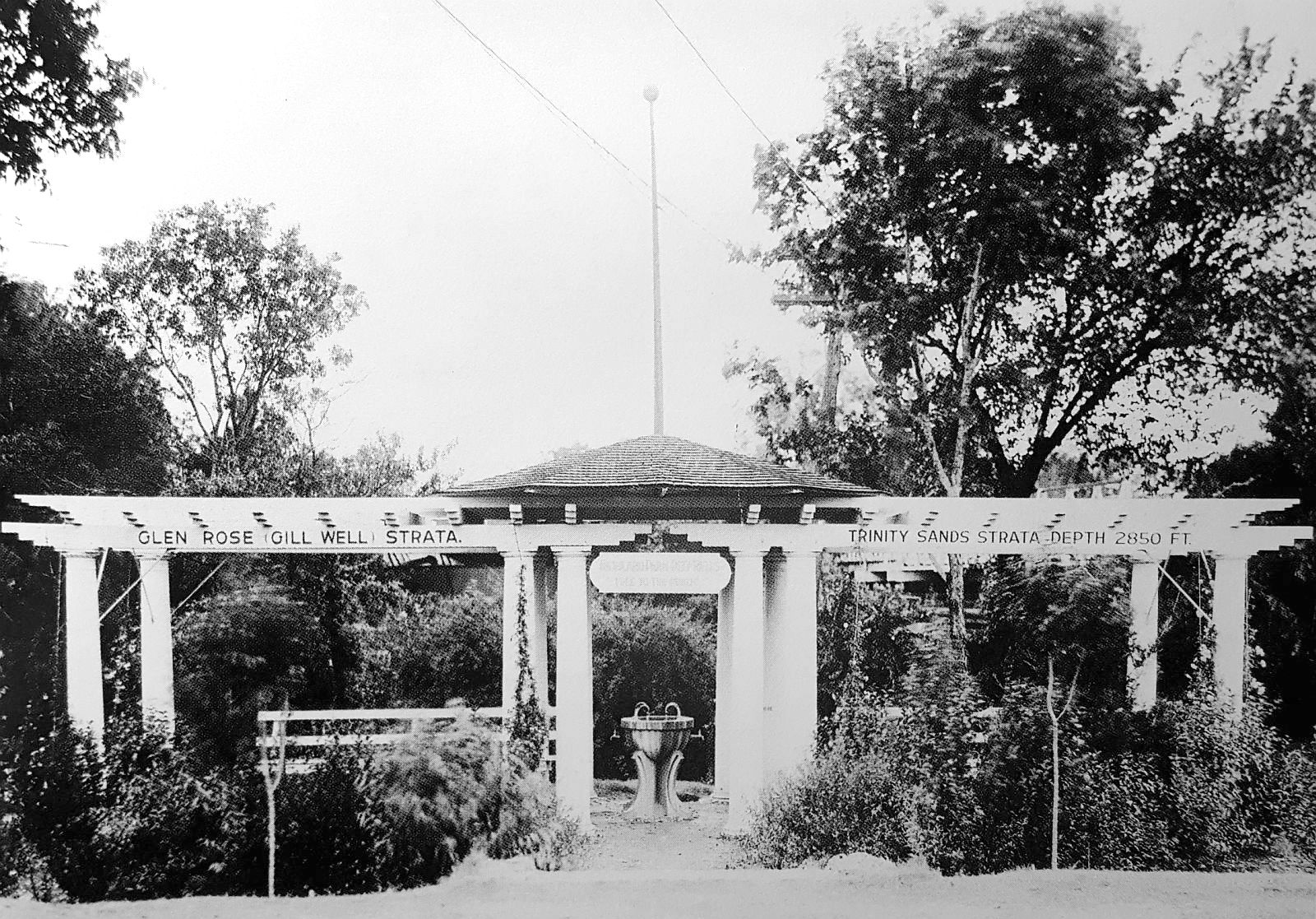
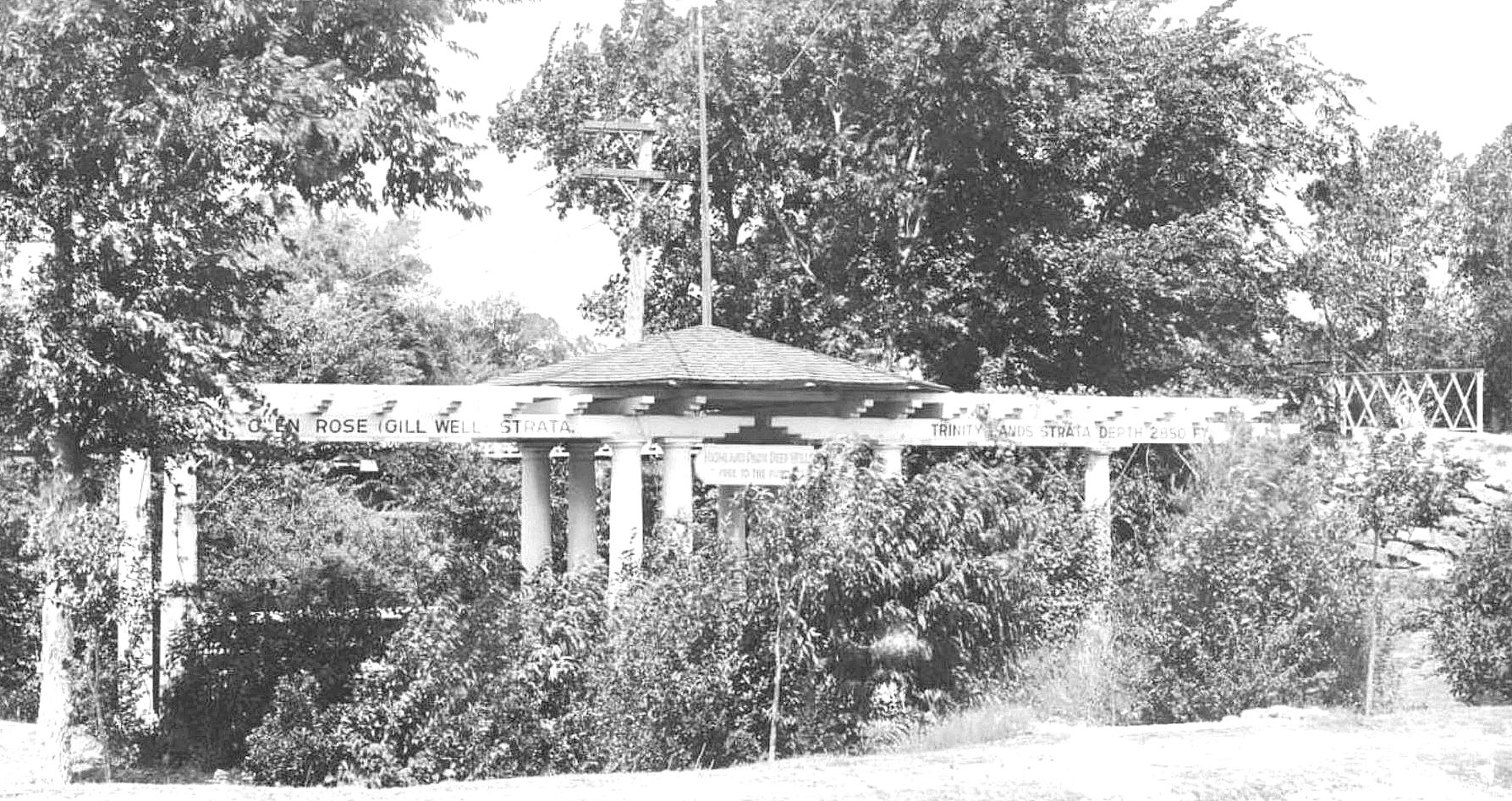
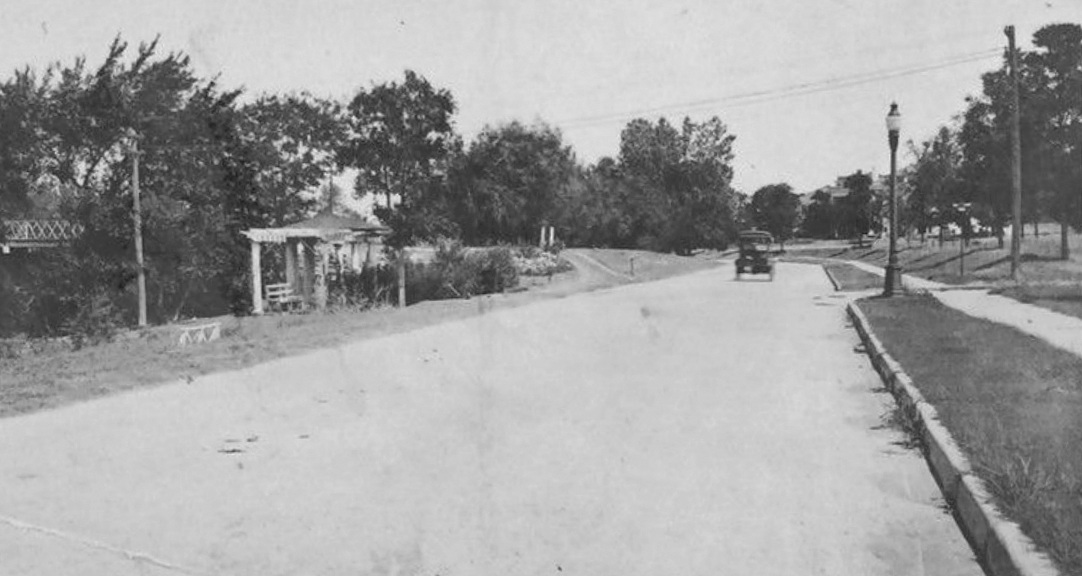
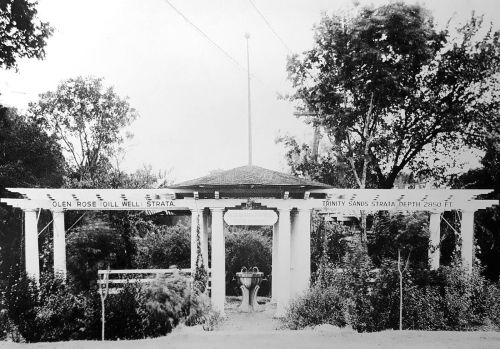
Around 1924, “Gill water” tapped from the Glen Rose Strata was made available to Highland Park, via a small “watering house” and drinking fountain on Lakeside Drive (at Lexington), a location which proved to be quite popular. The mineral water was a byproduct of Highland Park’s “deep well” which was drilled in 1924 to tap the pure artesian springs of the Trinity Sands Strata in order to augment the water supply of the City of Highland Park: in order to get down to the Trinity Sands, one had to pass through the Glen Rose Strata — I guess the HP powers-that-be figured they might as well tap the hot mineral water and offer their citizens access to it by building a small fountain and dispensing station. In 1928, the little “watering station” structure was spiffed up with the addition of a tile roof, attractive walkways, and drainage. The photo seen at the top of this post has frequently been misidentified as the Reverchon Park well, but it is actually the Highland Park “pagoda.” Here it is again:

gill-well_highland-park_dallas-rediscoveredfrom the book Dallas Rediscovered

It can be identified as the Highland Park location because of the photo below from the George W. Cook collection of historic Dallas photos from SMU’s DeGolyer Library — it shows what appears to be a later view of the same pagoda, now slightly overgrown. The steps to the bridge across Exall Lake and the bridge’s railing can be seen at the far right (the bridge led to the Highland Park pumping station, which can be seen on a pre-watering-station 1921 Sanborn map here).

gill-well_highland-park_cook-collection_degolyer_smuGeorge W. Cook Collection, SMU

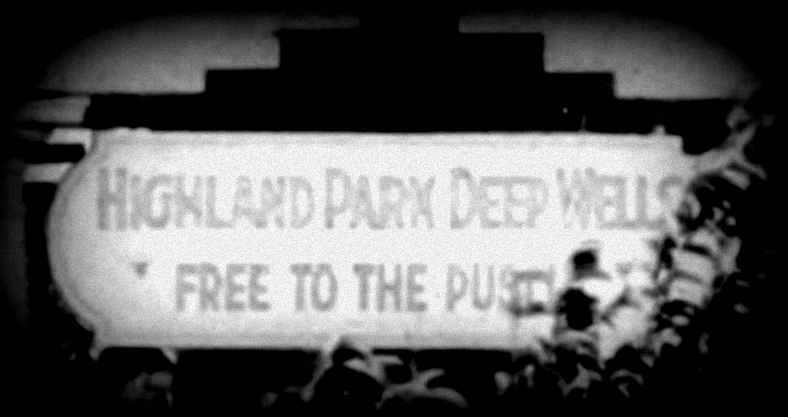
And, well, there’s the sign that reads “Highland Park Deep Wells — Free to the Public” — here’s a close-up:
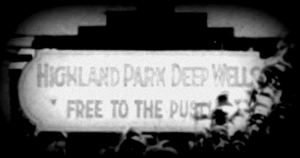
gill-well_highland-park_cook-collection_degolyer_smu_det

(The same sign from the top photo can be seen in a high-contrast close-up here.)

After seeing this photo, I realized that a photo I featured in a post from last year showed the pagoda in what looks like its earliest days, at Lakeside Drive and Lexington Avenue (the bridge can be seen at the left):
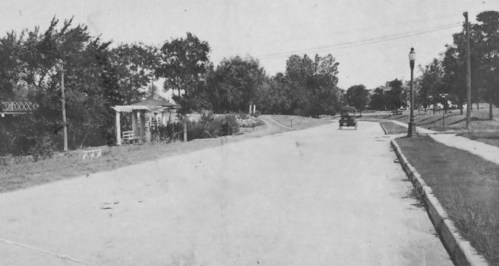
hp_lakeside-drive_rppc_ebayeBay

I was unable to find out when this HP pagoda bit the dust, but the location as seen today on Google Street View is here. (It’s pretty strange to think that a steady stream of people from all over Dallas drove to the Park Cities to fill up jugs with free mineral water; my guess is that the wealthy Lakeside Avenue residents weren’t completely enamored of the situation.)

Reverchon Park Pavilion

Even though the Gill Well Sanitarium Co. had dissolved in 1916, and the last traces of its buildings had been torn down in 1923, the famed well’s water didn’t disappear from the immediate Oak Lawn area. In February of 1925, the City of Dallas opened a $5,000 pavilion, “making up for twenty years indifference to what is said to be the finest medicinal water in the South” (DMN, Feb. 11, 1925). This pet project of Mayor Louis Blaylock seems to have continued to be a place for Dallasites to get their mineral water at least through the 1950s, according to online reminiscences. This 1925 “pavilion” is described thusly in the WPA Dallas Guide and History:

The water, which resembles in many respects the mineral waters of European resorts and is used in several county and city institutions, is carried to the surface in pipes and can be drawn from taps arranged around a semicircle of masonry near the entrance to the park. Here cars stop at all hours of the day and people alight to drink the water or to fill bottles and pails.

I have not been able to find a photograph of that post-sanitarium dispensing site. A 1956-ish aerial photo of Reverchon Park can be found here. I don’t see a “semicircle of masonry” in an area I assume would be located near Maple Avenue and the Katy tracks.

According to a comment on the DHS Archives Phorum discussion group, there was also a public spigot nearer to the original well, along Oak Lawn Avenue, across the street from Dal-Hi/P. C. Cobb stadium.

There is surprisingly little accurate information on the Gill Well online. I hope this overview helps correct some of the misinformation out there. If anyone knows of additional photos of the sanitarium and/or natatorium, please send them my way and I’ll add them to this post. If there are any photos of the Reverchon Park pavilion, I’d love to see those as well. There is a 1926 photo of the Highland Park location which shows two women and two girls filling receptacles — I am unable to post that here, but check the Dallas Morning News archives for the short article “Free Mineral Well Waters Popular” (DMN, May 29, 1926).

**

Incidentally, even though the wells have been capped, that hot mineral water is still there underground and could be tapped at any time. Dallas could still be the “Hot Springs of Texas”!

***

Sources & Notes

Top photo is from p. 199 of Dallas Rediscovered by William L. McDonald. The photo is incorrectly captioned as showing the location of the “Gill Well Bath House and Natatorium, c. 1904” — it is actually the Highland Park dispensing station at Lakeside Drive and Lexington Avenue in about 1928.

“Morning” postcard featuring healthy bathing patrons of the natatorium is from the collection of the Texas Swimming and Diving Hall of Fame and is used with permission.

Photo showing Maple Avenue, pre-straightening, is from the Big D History Facebook page; original source of photo is unknown.

Second photo of the Highland Park Gill Well location (with the vegetation looking a bit more overgrown) is from a postcard captioned “Drinking Bogoda [sic], deep mineral well in Highland Park, Dallas, Texas” — it is from the George W. Cook Dallas/Texas Image Collection, DeGolyer Library, Central University Libraries, Southern Methodist University; more information on this image is here.

Photo showing Lakeside Drive with the pagoda at the left is a real photo postcard captioned “Lake Side Drive in Highland Park” — it was offered last year on eBay.

Sources of all other clippings, ads, and maps as noted.

*

Copyright © 2017 Paula Bosse. All Rights Reserved.